BCM Software for Intelligent Business Continuity Management
TopEase, F24’s GRC platform, supports the entire BCM process in accordance with ISO 22301 and BSI 200-4

We are here for you.
Arrange a personal and unbinding demo appointment now.
What is Business Continuity Management (BCM)?
Business Continuity Management (BCM) – also known as operational continuity management – refers to the systematic approach organizations use to ensure the continuation of critical business processes during and after disruptions, outages, or crises.
A structured Business Continuity Management System (BCMS) includes:
- Business Impact Analysis (BIA): Identification and assessment of critical business functions and resources
- Business Continuity Management Plan: Documentation of emergency strategies and response measures
- Recovery Planning: Structured transition from emergency operations to normal operations
- Tests & Audits: Regular review of the effectiveness of the BCM system
- Continuous Improvement: Monitoring, reporting, and further development of the BCMS
TopEase’s BCM software digitally maps the entire process within an integrated, automated platform – available on-premises or as cloud.
BCM with TopEase: Your Benefits for Seamless Business Continuity
A Complete BCM Process in a Single System
- From the BCM concept to the BIA to the recovery plan – everything is centralized, with no media breaks and no redundancies.
Automated and Intelligent BIA
- TopEase automatically identifies all the elements to be evaluated based on targets and lifecycle information. Criticality and impact analyses are conducted more efficiently and with greater transparency.
Ready for an audit at any time
- Audit-compliant documentation, version control, and traceability for ISO 22301 certifications, BSI 200-4 audits, and NIS 2 compliance.
A quick, targeted response in an emergency
- Measures are intelligently linked to risks, controls, and architectural assets. In the event of an emergency, you can respond quickly and in a structured manner – based on up-to-date data.
Widespread acceptance throughout the company
- Process owners are integrated into the BIA in a decentralized manner via digital queries and web views – intuitively and with minimal training required.
Flexible Operating Models
- Choose the hosting option that best suits your needs: traditional on-premises, in the public cloud, or at the F24 data center in Switzerland – with no functional limitations.
The Typical Challenges in Day-to-Day BCM Operations

Fragmented tools and data silos
BCM plans in Excel, BIAs in separate documents, audits via email – without a centralized overview, it’s hard to keep track of everything. Duplicate data entry wastes time and increases the risk of errors. On top of that, there are hurdles when it comes to cross-departmental BIAs.

Manual BIA processes are resource-intensive
Creating and maintaining business impact analyses in Excel is error-prone and time-consuming – especially when there are complex dependencies between processes, systems, and suppliers.

Increasing Regulatory Requirements
ISO 22301 (first edition May 2012, revised October 2019) BSI 200-4, NIS-2 (effective January 2023, applicable as of October 2024) and DORA (effective January 2023, applicable as of January 2025) set forth specific and detailed requirements for BCM – and require complete, audit-proof documentation.

Audit Preparation as a Burden
Scattered documentation, a lack of version control, and unclear responsibilities make BCM audits time-consuming and stressful.

Silo mentality hinders true resilience
BCM, risk management, and IT security are often managed separately. A lack of coordination leads to blind spots and, in an emergency, to slow responses.

Complex Restart Planning
Managing the transition from emergency operations to normal operations in a structured manner is virtually impossible without an integrated business continuity management system – especially in international supply chains.
From business impact analysis to the recovery plan
TopEase guides you through the entire BCM process in accordance with ISO 22301 – from the initial analysis to robust recovery planning.
Automated assessments, integrated links to risks and controls, and clearly visualised plans provide the transparency that CISOs and IT security managers need to meet regulatory compliance requirements (including NIS2 and DORA).
How TopEase Digitizes Your Business Continuity Management
Business Continuity Management (BCM) – also known as operational continuity management – refers to the systematic approach that companies use to ensure the continuity of critical business processes during and after disruptions, outages, or crises.
A structured business continuity management system (BCMS) includes:
TopEase’s BCM software digitally maps the entire process within an integrated, automated platform – either on-premises or as cloud solution.
1. Analyze
Analyze
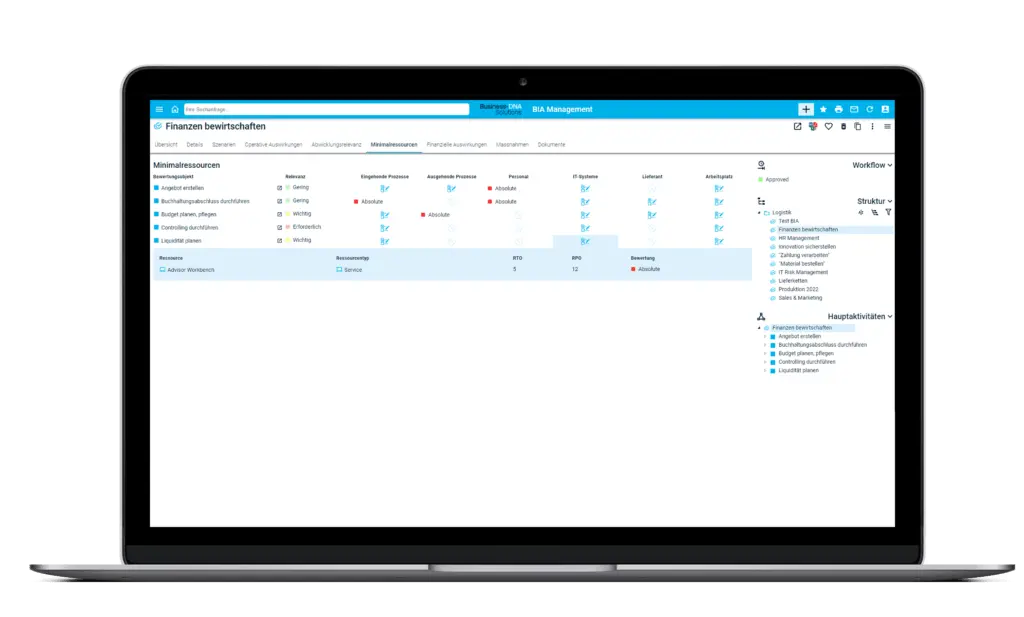
- Conduct business impact analyses (BIA) in a structured manner.
- TopEase automatically determines all relevant assessment criteria. Criticality analyses, impact analyses, and minimum resource requirements are generated efficiently and are directly linked to processes, assets, and suppliers.
2. Plan
Plan
- Develop your own customized and adaptable business continuity management system.
- Value chains and supply chains are fully mapped, including all dependencies and interfaces.
3. Test & Monitor
Test & Monitor
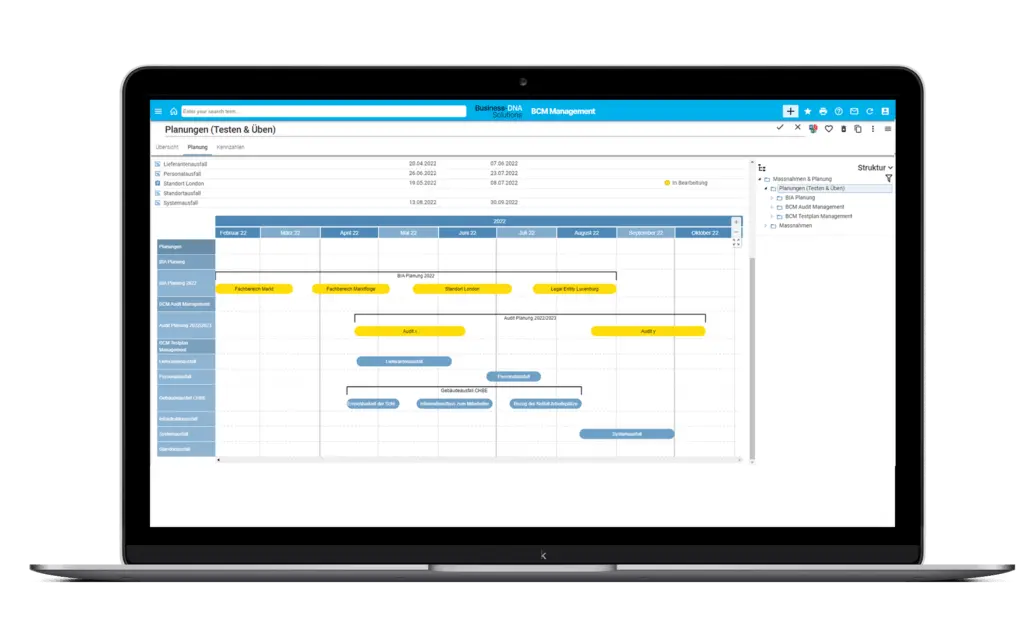
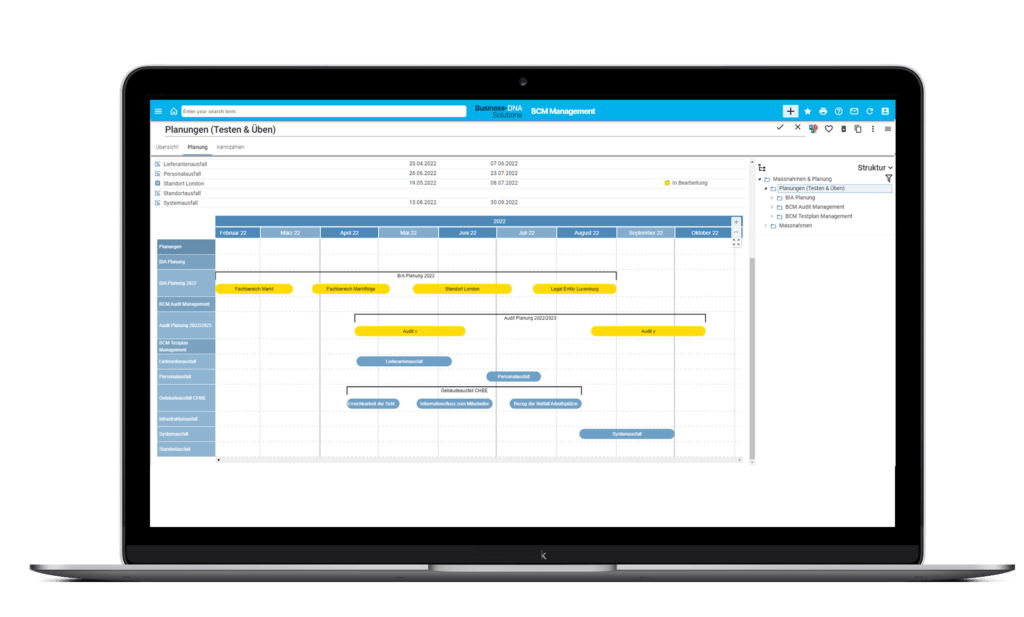
- Plan and document BCM tests and audits using the Plan-Test-Check cycle.
- Measures are automatically visualized, managed, and monitored—the transition from emergency operations to normal operations is managed in a structured manner.
4. Improve & Report
Improve & Report
- Continuous improvement of the BCM through automated monitoring, KRI tracking, and configurable reports suitable for management.
- You are prepared to provide information to regulatory authorities at any time.
Do you know that feeling of getting lost in data chaos and manual processes during your day-to-day BCM work?
Discover how TopEase efficiently and comprehensively addresses your specific challenges, allowing you to approach your next audit with confidence.
An Overview of the Features of the BCM Software Module
| Functions | Your Benefits |
| Business-Impact-Analysis (BIA) | Automated analysis of critical functions, resources, and dependencies – including recovery time estimation |
| Business-Continuity-Management-Plan | Structured development, documentation, and versioning of BCM plans in a single system |
| Restart Planning & Shutdown Planning | Control and Visualization of the Transition from Emergency Mode to Normal Operation |
| Test & Audit Planning | Plan-Test-Check Cycle for Structured BCM Tests, Exercises, and Audits |
| Risk and Control Linkage | Risks, controls, and architecture assets are intelligently interconnected – no data silos |
| Supply Chain Documentation | Value chains and supply chains, including all dependencies, interfaces, and third parties |
| Automatic Reporting | Customized reports for management, regulatory authorities, and stakeholders – at the click of a button |
| Plan and Document Generation | Includes automatic generation of emergency manuals, business continuity plans (BCPs), and recovery plans at the click of a button |
| Digital Twin of the Organization | Comprehensive mapping of processes, IT systems, assets, and locations |
| Modular Integration | Seamless integration with risk, process, control, and security management |
| KRI-Monitoring in Real Time | Automatic threshold and trend calculation for continuous risk monitoring |
| API- und Dataintegration | Interfaces to third-party systems (e.g., CMDB, ERP) to ensure that assets and resources are always up to date |

Our TopEase-BCM Module in Practice
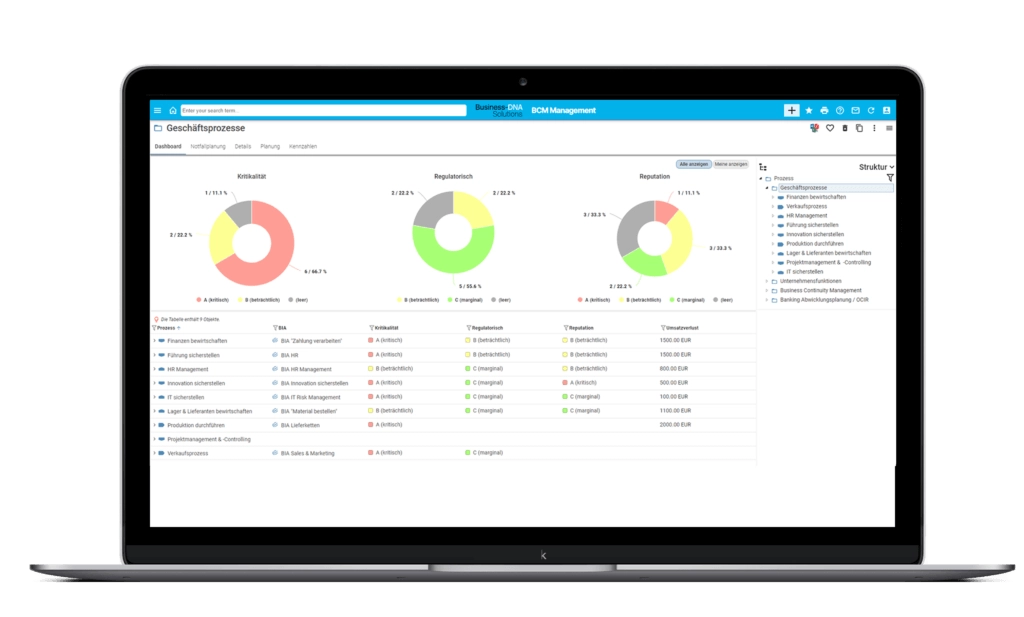
BCM Dashboard

Criticality analysis

Why choose TopEase over manual processes and standalone BCM tools?
| Manual Processes | Isolated BCM-Software | TopEase-BCM | |
| BIA-automation | x | partly | yes – completely |
| BCM ISO 22301-compliant | x | partly | yes |
| BSI 200-4-compliant | x | partly | yes |
| NIS-2-ready | x | limited | yes |
| DORA-compliant ICT-Mapping | x | isolated | yes |
| Integration Riskmanagement | x | x | yes – natively integrated |
| Supply Chain Management | x | limited | yes – completely |
| Automatic Reporting | x | limited | yes |
| Audit-compliant documentation | x | limited | yes |
| On-Premise & Cloud | x | mostly only Cloud | both |
| Modular Expansion | x | x | yes |
| Digital Twin | x | x | yes |
BCM Standards and Regulations – TopEase Is Here to Help
ISO 22301: The International BCM Standard
- DIN EN ISO 22301 is the globally recognized standard for business continuity management systems (BCMS). It defines requirements for the planning, establishment, operation, monitoring, and continuous improvement of a BCMS.
- TopEase supports the entire BCM-ISO process in accordance with ISO 22301—from context analysis and BIA to internal auditing and preparation for ISO 22301 certification.
BSI 200-4/BSI Standard 200-4: The German BCM Framework
- The BSI Standard 200-4, issued by the Federal Office for Information Security, defines the German standard for emergency management and business continuity management. It is specifically intended for government agencies, KRITIS operators, and companies with high availability requirements.
- TopEase supports all requirements of BSI 200-4 – including BCM emergency plans, recovery plans, and structured documentation in accordance with BSI guidelines.
NIS 2 Directive: BCM as a Mandatory Component
- The NIS 2 Directive (EU NIS 2) requires companies in critical and important sectors to implement comprehensive cybersecurity measures starting in 2025. This explicitly includes business continuity management (Article 21, paragraph 2c): BCM plans, backup management, disaster recovery, and crisis management.
- TopEase supports NIS 2-compliant BCM documentation, record-keeping, and automated reporting for regulatory authorities.
DORA: Business Continuity for Financial Service Providers
- The Digital Operational Resilience Act (DORA) requires financial service providers to implement specific BCM measures to ensure digital operational resilience.
- TopEase seamlessly integrates BCM with DORA compliance into a single system.
ISO 27001: Linking BCM and Information Security
- Business continuity management is an integral part of ISO 27001.
- TopEase integrates both areas into a single database – without any redundancies. Learn more about TopEase’s Information Security Management System module.
Who is TopEase-BCM suitable for?
Business Continuity Manager
You develop, test, and maintain business continuity management plans and need a system that centrally manages all tasks – from the BIA to the audit. TopEase reduces manual effort and keeps all plans and documents up to date at all times.
Risk Manager
You closely link BCM to risk management and need an integrated view of risks, controls, and continuity measures. TopEase provides exactly this interconnected perspective – without data silos.
CISO / CSO
You are responsible for information security and must demonstrate compliance with BCM requirements under NIS-2, DORA, and ISO 27001 to regulatory authorities. TopEase integrates BCM and security management into a single database.
Head of Risk Management
You report to the executive board and need management-ready dashboards and automated reports. TopEase provides up-to-date BCM status reports at the click of a button.
Particularly relevant for the following industries:
- Finance sector: DORA, MaRisk, ISO 22301
- Critical Infrastructure (KRITIS) : NIS-2, BSI KRITIS
- Industry & Manufacturing: ISO 22301, BSI 200-4
- Health Care:
NIS-2, country-specific requirements
- Public institutions:
BSI 200-4, NIS-2
“With TopEase, we are establishing an integrated, object-oriented approach to linking enterprise architecture and GRC management – in a transparent and controllable manner.”
B. Schmidiger, RUAG MRO Holding AG

FAQ about BCM Software and TopEase
BCM that really works when it counts. Experience it live now.
Experience in a free live demo how TopEase digitizes your BCM – from business impact analysis to an audit-ready recovery plan. Our experts will give you a live demonstration of the platform – tailored to your requirements in accordance with ISO 22301 and BSI 200-4.
F24 – The good feeling of being prepared for all critical situations as a company.The good feeling of being prepared for all critical situations as a company.
We are here for you.
We are happy to answer your questions about TopEase.

You might also be interested in

Risk Management (NFR)
Capture, assess and manage non-financial risks in a structured manner – with a customisable risk map, KRI monitoring and automated workflows.

Control Management (ICS)
Supports the establishment, evaluation and audit-proof documentation of controls – for structured assessment and control management.

Processmanagement (BPM)
Visualises business processes and links them to risks, controls and assets – for a transparent, silo-free process landscape