Risk Management Software Solution for Non-Financial Risks (NFR)
With TopEase, F24’s GRC platform, you capture, assess, and manage risks centrally – using risk assessments, a risk map, workflows, measures, reports, and intelligently linked data.

We are here for you.
Arrange a personal and unbinding demo appointment now.
What is TopEase Risk Management?
TopEase Risk Management is a risk management software for digital risk management and non-financial risks (NFR) – including cyber and supply chain risks as well as operational and regulatory risks. As a module of F24’s GRC platform, the solution can be used on its own or combined with additional modules to form a holistic GRC risk management.
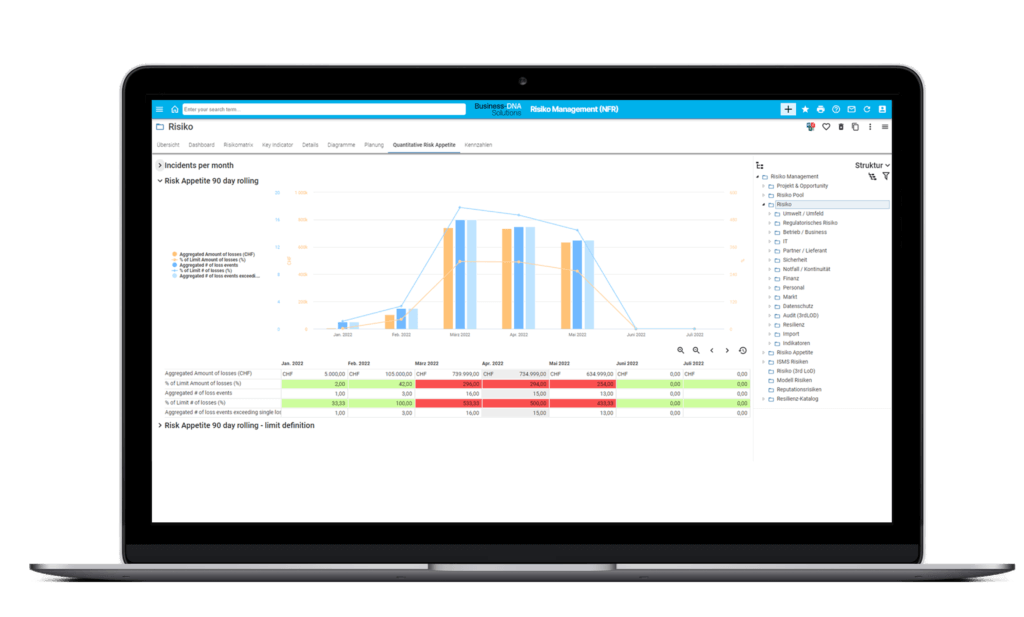
Across the entire risk management process, TopEase helps companies capture risks centrally, assess them qualitatively and quantitatively, manage measures, and visualize developments via a risk map. Targets and Key Risk Indicators (KRI) keep the risk situation measurable and traceable at all times..
In this way, TopEase connects risk assessments, risk governance, workflows, analyses, reports, and linked data in a redundancy-free database. A central dashboard for risk management gives management, oversight, and specialist departments an up-to-date overview at all times – at the click of a button and audit-ready.
Identify Risks Before They Turn Into Crises
Fragmented Processes Lead to Delayed Decisions
Many risk management processes still rely on Excel lists, manual queries, and isolated reports. This creates media breaks, redundant data, and delayed decisions – especially when cyber risks, supply chain disruptions, geopolitical risks, or regulatory requirements occur simultaneously.
A Central Database for Proactive Action
TopEase creates a central, up-to-date, and traceable database for risks, measures, and responsibilities, enabling companies to identify connections early and act before risks turn into crises.
What Should Companies Look for in Risk Management Software?
Don’t Just Document – Connect
- Don’t just capture risks – link them with assessments, measures, and responsibilities.
- Consolidate reports and dependencies in a central, redundancy-free database instead of isolated tools.
What Matters When Making Your Choice
- Flexible risk assessments with a traceable assessment logic as well as role and permission concepts.
- Reporting, integrations, and data import – including the linking of risks with processes, controls, and assets.
Digital Risk Management with a Central, Redundancy-Free Database
TopEase consolidates all information for risk assessment and risk management in one place. Risks, scenarios, measures, targets, status, responsibilities, and links are centrally documented, managed traceably, and evaluated automatically.
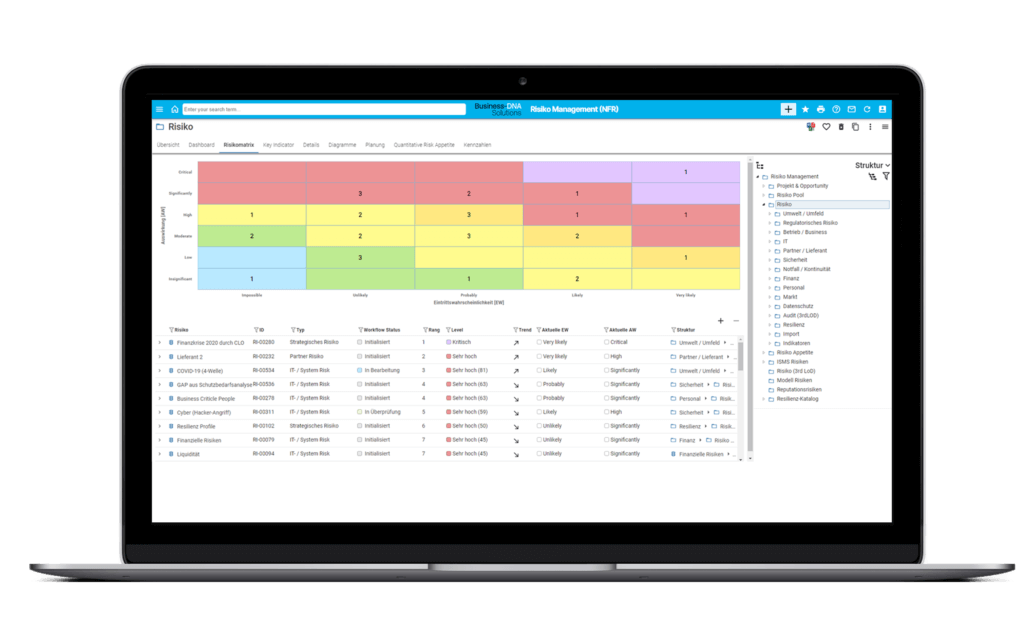
The result: complete risk governance in a single system with qualitative and quantitative assessment, an individually configurable risk map, and a direct interface to the internal control system (ICS).
Features of the TopEase Risk Management Software

Risk Assessments and Questionnaire
Workflow-driven, configurable questionnaires with predefined answers, attachments, and links for structured risk assessments across various target groups and areas.

Risk Map and Individual Visualization
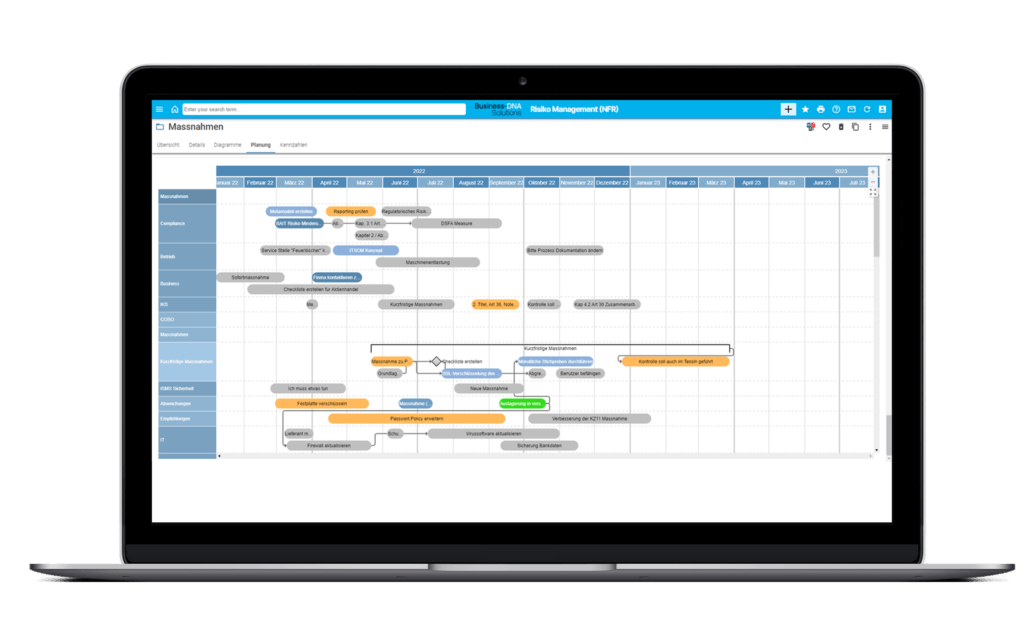
Current, planned, and target risk positions as well as measure plans and intervention scenarios are displayed visually – customizable for management and oversight.

Risk Governance and Targets
Capture, measure, and manage targets; map risk governance holistically in a single system, with clear responsibilities and escalation paths.

Workflows, Analyses, and Reports
Process risks on a rule-based basis, manage status and permissions, and automatically generate analyses and reports – for management, oversight, and operational staff.

Impact Analysis
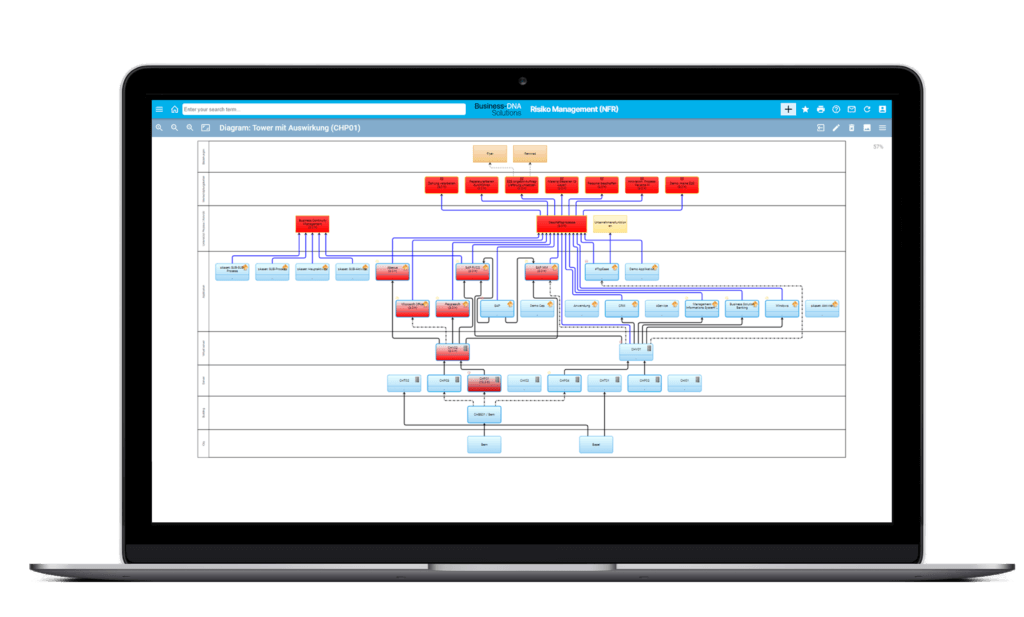
Assess impacts and dependencies, including automatic recovery time estimation in the event of a system failure. This enables well-founded decisions even under time pressure.

ICS and Asset Linkage
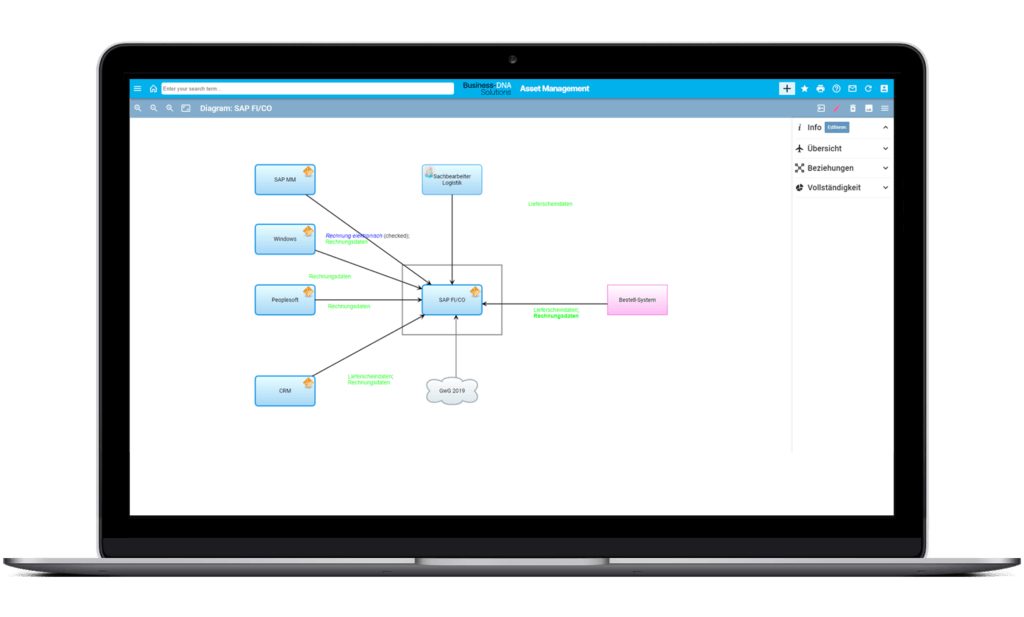
Connect risks with the internal control system and architecture assets – for an integrated GRC risk management overview without data silos.
See TopEase in Action
Global risks and changes are on the rise – from cyber threats and supply chain disruptions to new regulatory requirements. The video shows why structured, digital risk management is essential today to stay capable of acting.
You’ll then see how TopEase makes this complexity manageable: risks are captured and assessed centrally, visualized via the risk map, and linked with measures, responsibilities, and Key Risk Indicators.
This gives you a compact overview of the key features of the risk management software – from risk assessments and workflows to automated reporting in a central database.
Map the Risk Management Process Digitally
1. Identify
Identify
- Capture risks, scenarios, and dependencies in a structured, cross-platform manner
- A central foundation for an end-to-end risk management process
2. Assess
Assess
- Qualitative and quantitative assessment with configurable risk assessments
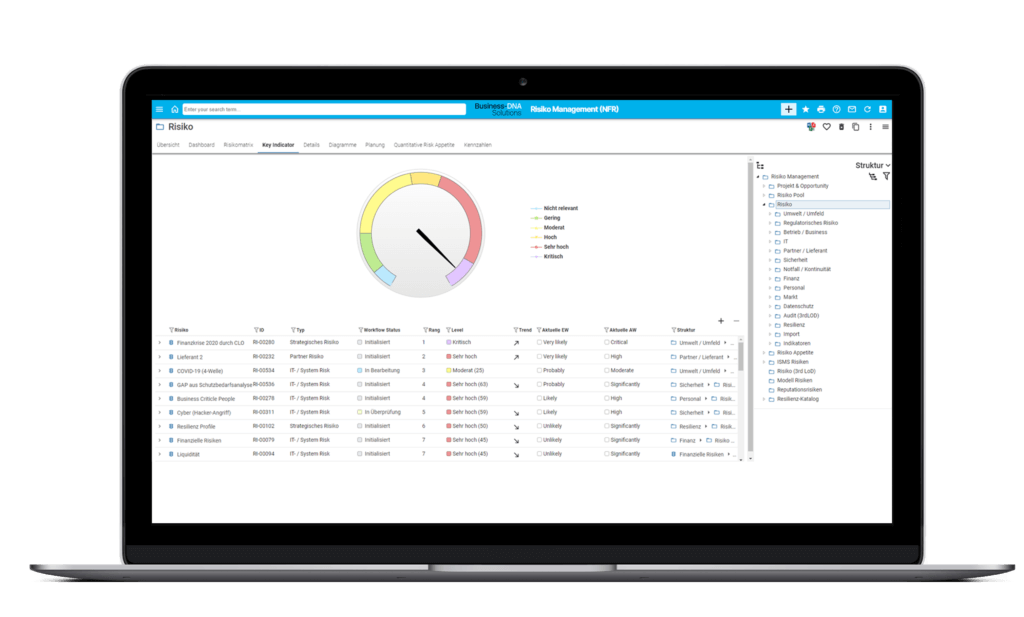
- Key Risk Indicators (KRI) make developments measurable and comparable
3. Visualize
Visualize
- Current risk situation, target position, and measure plans at a glance in the risk map
- Individually configurable for management, oversight, and specialist departments
4. Manage
Manage
- Assign and escalate measures, deadlines, and responsibilities on a rule-based basis
- Risk governance traceable at all times in a single system
5. Monitor & Report
Monitor & Report
- Automated monitoring and KRI tracking for risks and targets
- Dashboard for risk management with information-ready reports

Risk Management Software for Companies with Complex Non-Financial Risks
Whether Risk Management, GRC/Compliance, or complex supply chains – TopEase adapts to your use case.
Target Group
- Risk Management
- GRC / Compliance
- Non Financial Risk Management
- Operational Risk Management
- Finance Sector & Regulated Companies
- Companies with Complex Supply Chains
- Organizations with Reporting Obligations
Typical Needs
- Structured risk capture, assessment, and management
- GRC risk management, record-keeping, reporting
- NFR management, operational risks, scenarios
- Process risks, failure risks, dependencies
- MaRisk, DORA, regulatory risk obligations
- Supply chain risks, third-party dependencies
- Automated reporting, audit readiness
Risk Management as a Focused Module of the TopEase GRC Platform
The TopEase risk management module can be used on its own and unfolds its full potential when used as part of the modular TopEase GRC platform. Because risks don’t arise in a vacuum: they are connected with processes, controls, assets, supply chains, and regulatory requirements.
This way, teams see not only individual risks but also their causes, dependencies, and impacts on processes, controls, or assets.
When the risk management module is combined with other TopEase modules such as ICS, BCM/BIA, DORA, Process Management or EAM the result is an integrated view of the entire risk landscape. Risks can thus be linked directly with controls, critical processes, recovery plans, regulatory requirements, and architecture assets. This facilitates prioritization, measure management, and traceable reporting.
Start with the risk management module and expand your GRC platform step by step as new requirements arise.
How GRC Risk Management with TopEase Works in Practice
- Risk Matrix
- Configurable Questionnaire
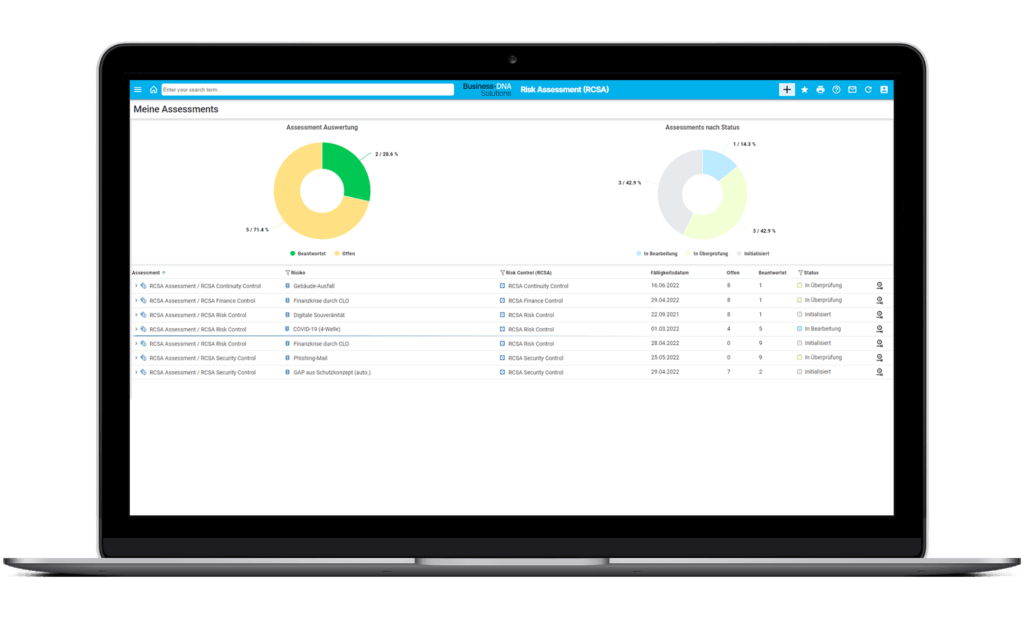
- Overview of Open Assessments
- Consolidated Key Figures
- Consolidated Measures
- Impact Analysis
- Key Risk Indicators
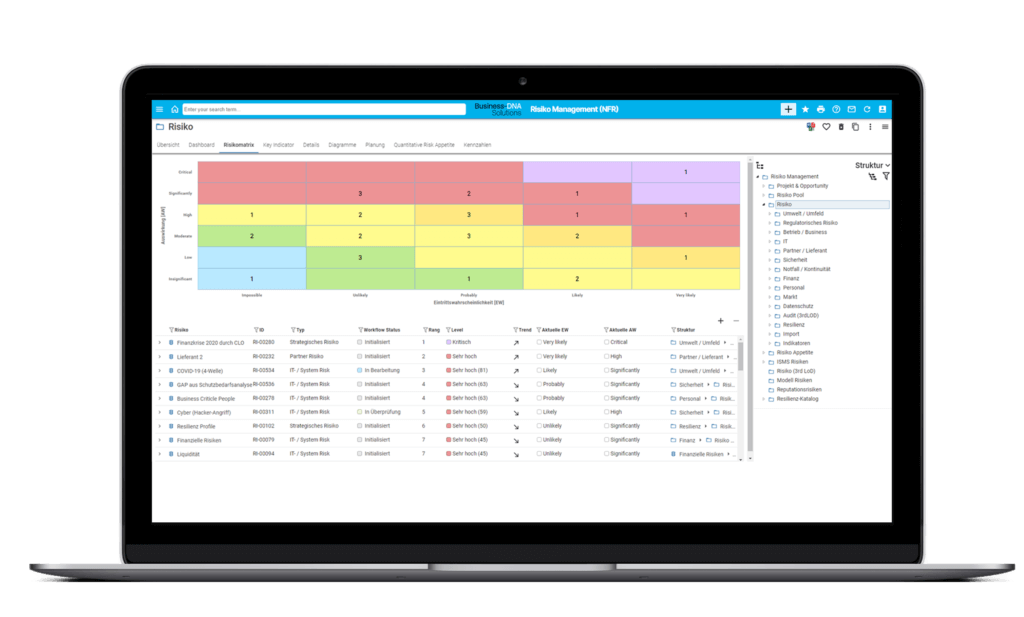

Overview of Open Assessments
“With TopEase, we are establishing an integrated, object-oriented approach to linking enterprise architecture and GRC management – in a transparent and controllable manner.”
B. Schmidiger, RUAG MRO Holding AG

FAQ about the TopEase Risk Management Software
We are here for you.
We are happy to answer your questions about TopEase.
Ready for structured risk management? Get to know TopEase.
Experience in a free Live-Demo , how TopEase digitizes your risk management – from risk capture through the risk map to automated reporting. Our experts will give you a live demonstration of the platform – tailored to your specific NFR requirements.
F24 – The good feeling of being prepared for all critical situations as a company.

You might also be interested in

Business Continuity Management (BCM)
Helps organisations to plan business continuity in a structured manner – from business impact analysis to recovery plans, in accordance with ISO 22301 and BSI 200-4.

Control Management (ICS)
Supports the establishment, evaluation and audit-proof documentation of controls – for structured assessment and control management.

Processmanagement (BPM)
Visualises business processes and links them to risks, controls and assets – for a transparent, silo-free process landscape