Full Compliance with the Digital Operational Resilience Act – Automated & Audit-Ready
Digitize all requirements using our DORA module.

We are here for you.
Arrange a personal and unbinding demo appointment now.
What is the Digital Operational Resilience Act (DORA)?
The Digital Operational Resilience Act (DORA) is an EU regulation that has been mandatory for all financial service providers operating in Europe since January 17, 2025. It requires companies in the financial sector to implement comprehensive measures to ensure digital operational resilience – not only within their own organizations, but also among their affiliated ICT service providers.
DORA Overview:
- Effective Date: January 17, 2025
- Applies to: EU financial institutions and relevant third-party ICT providers
- Key areas: ICT risk management, incidents, testing, third-party risk
- Critical evidence: complete register of third-party ICT providers
- Supervision: BaFin, ECB, or European supervisory authorities, depending on the institution
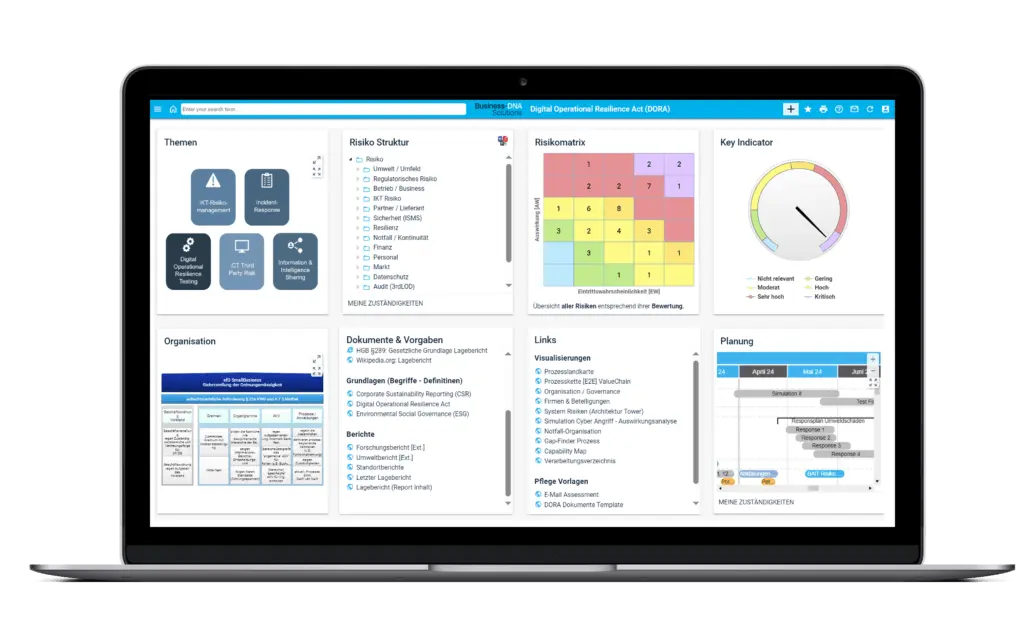
TopEase maps all DORA-related data, processes, and documentation in a single system – audit-ready, in real time, and without silos
We are here for you.
We are happy to answer your questions about TopEase.
Achieve the following with TopEase’s DORA Module
Always ready to provide information to BaFin
- All DORA-related data, analyses, and reports are centralized in one place: free of redundancies, up-to-date, and intelligently linked. Management and regulatory authorities receive customized reports at the click of a button (including documented approval processes for executive management in accordance with Article 5 of DORA).
Automate DORA compliance instead of managing it manually
- System tests, assessments, and questionnaires are automatically distributed and evaluated. The rule-based data repository allows multiple assessments to be processed in a single step.
Rapid Implementation of the DORA Regulation
- TopEase is an established, experienced provider of DORA compliance solutions for the financial sector. Following a needs analysis and data mapping, the platform goes live within a few months – either on-premises or in the cloud, available 24/7.
Three-step reporting process secured
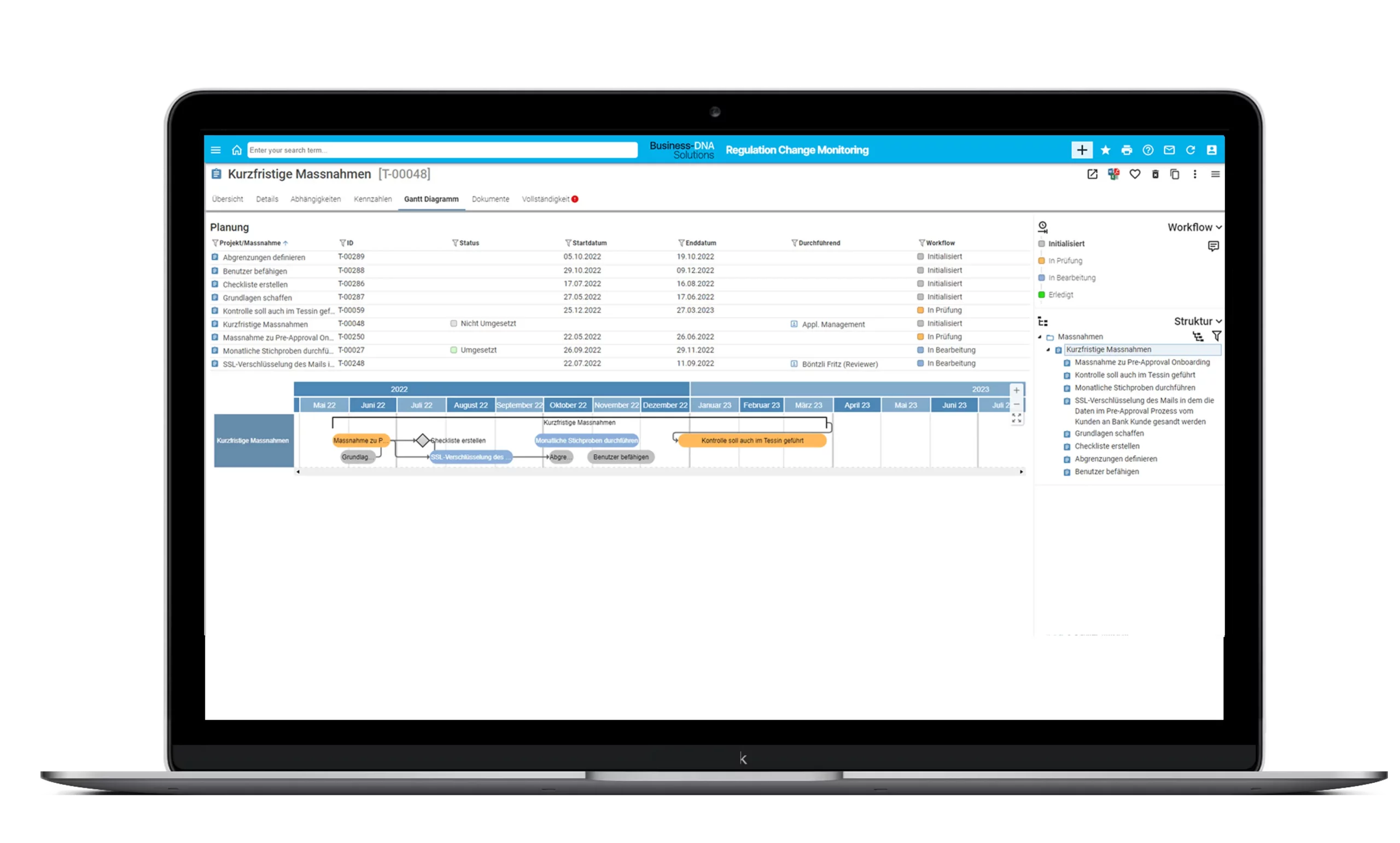
- Rule-based workflows automate the entire DORA incident reporting process – initial reports, interim reports, and final reports are reliably submitted in accordance with automated escalation rules, even under time pressure.
A Comprehensive View of the ICT Ecosystem
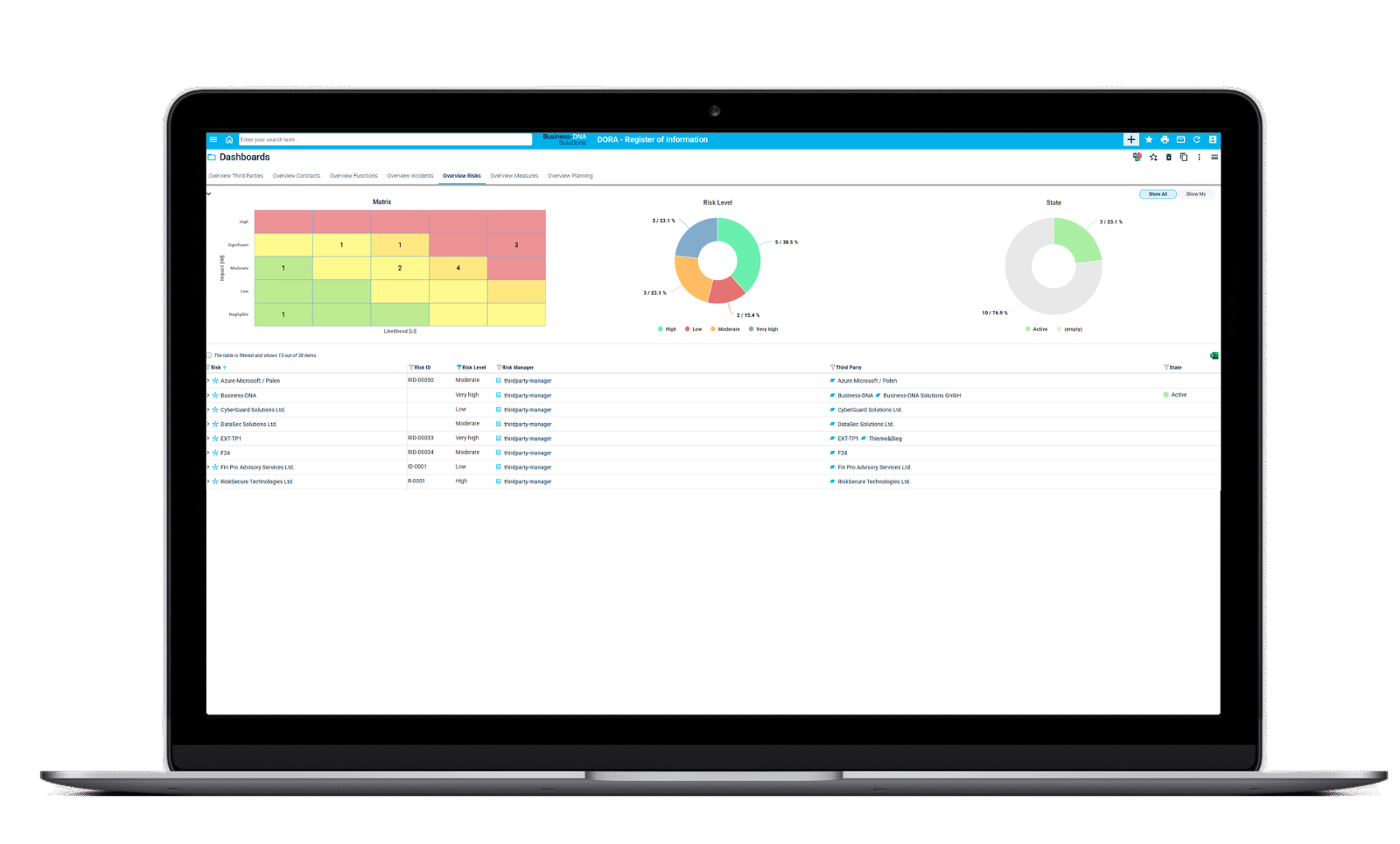
- TopEase maps ICT assets, third-party ICT providers (including subcontractors), contracts, and locations as a digital twin – consistently, completely, and without gaps in the DORA ICT Register.
Quick, targeted decisions
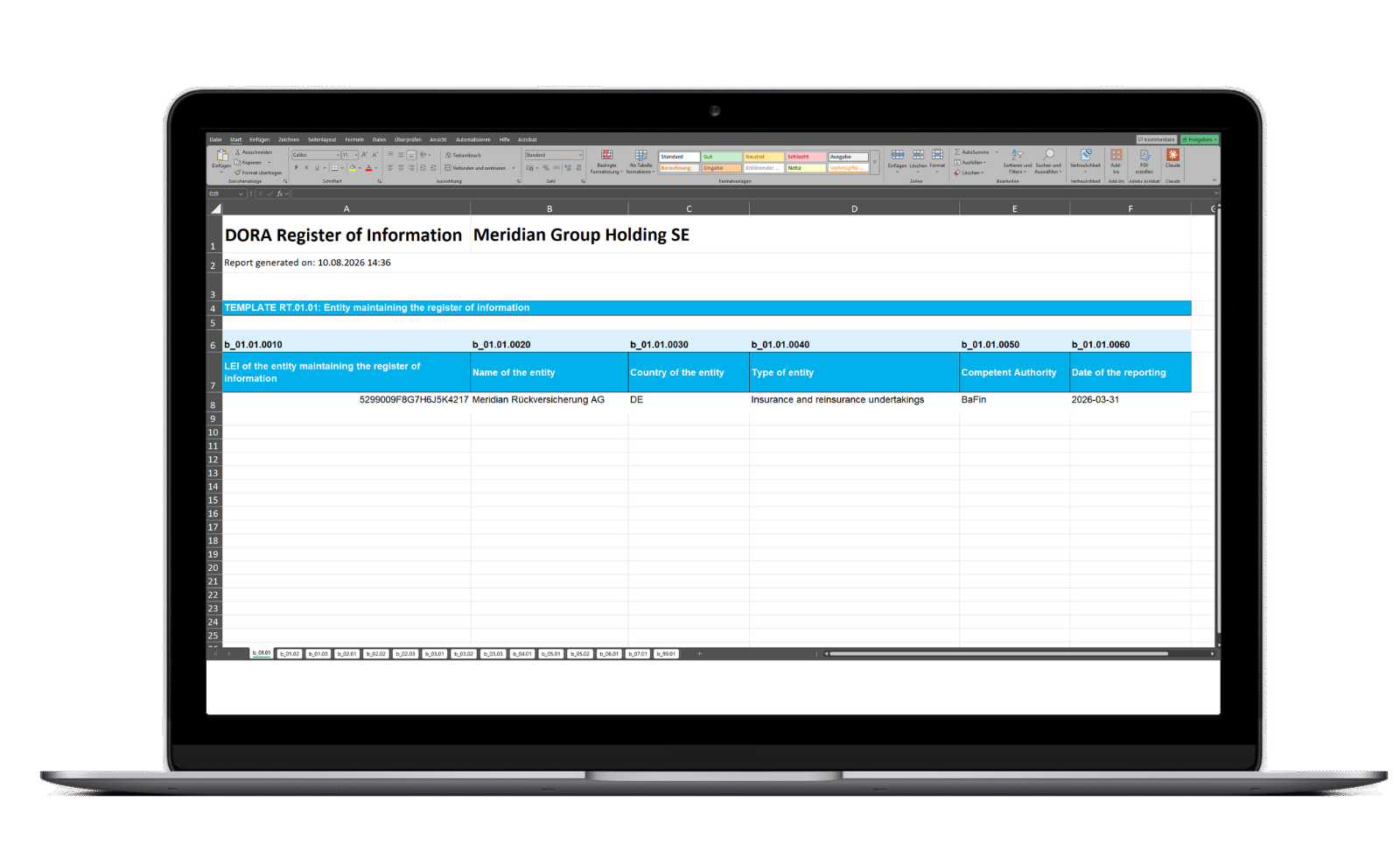
- The customizable risk map displays anomalies, trends, workflows, and areas requiring action – in real time, for both management and oversight.
Critical Vulnerabilities in Everyday DORA Operations

Fragmentation Is the New Regulatory Risk
Any organization that cannot provide a consistent, comprehensive overview of all ICT assets, third parties, and processes will fail a BaFin audit. Silos are no longer just an organizational problem; they are a regulatory risk.

Manual processes do not scale
DORA incident reports must be submitted no later than 4 hours after classification or no later than 24 hours after discovery; ongoing records; continuous documentation for regulatory authorities. Without systematic automation, this cannot be sustained over the long term.

Incomplete Third-Party Transparency
The third-party ICT provider registry must be complete, including subcontractors, criticality assessments, and data storage locations. Any omission constitutes an active audit risk with respect to BaFin.

ICT Risk Management Is Not Embedded in Operations
DORA requires that ICT risk management be approved by senior management and be effective in day-to-day operations, rather than merely existing on paper.

Missing proof of testing
BaFin requires the first evidence of resilience testing starting in 2026. For systemically important institutions: Threat-Led Penetration Tests (TLPT). Without structured test planning and documentation, a compliance gap arises.

Onboarding Third-Party ICT Providers: An Ongoing Challenge
Every new cloud provider, every new SaaS tool, and every contract renewal triggers DORA obligations: registration, criticality assessment, and entry in the registry. Without a systematic process, a compliance backlog continuously builds up during day-to-day operations, which BaFin does not reveal until the next registry reconciliation.
From ICT risk management and third-party registers to automated BaFin reporting
TopEase supports you in fully implementing the DORA Regulation – from mapping your ICT ecosystem to automated regulatory reporting.
A digital twin of your entire organisation, including third-party providers and contracts, provides the data foundation that CISOs and IT security managers need to produce robust, audit-proof evidence.
How TopEase Digitizes Your DORA Compliance
2026 is the year of the proof. BaFin has fully integrated DORA into its day-to-day supervisory review process. Formal DORA compliance is no longer enough – what’s required are robust processes, proven resilience, and complete transparency regarding all dependencies. TopEase supports you in this effort.
1. Capture & Organize
Capture & Organize
- Map out your entire business architecture digitally: ICT assets, third-party ICT providers (including subcontractors), contracts, and locations.
- TopEase automatically scans your architecture for vulnerabilities and regulatory risks in accordance with DORA requirements.
2. Evaluate & Manage
Evaluate & Manage
- Make quick, targeted decisions based on the customizable risk map.
- All DORA requirements are evaluated, prioritized, and accompanied by specific action plans. Relationships and dependencies are intelligently linked through a rule-based repository.
3. Testing & Verification
Testing & Verification
- Plan and automate resilience tests in accordance with DORA Articles 24–27: from basic system tests to threat-led penetration tests (TLPT) for systemically important institutions.
- TopEase documents all test results in an audit-proof manner, manages test planning within a continuous plan-test-check cycle, and ensures that evidence for BaFin is available at any time.
4. Report & Escalate
Report & Escalate
- Ensure timely DORA incident reporting in accordance with Articles 17–23 through rule-based escalation workflows.
- TopEase supports the entire three-step reporting process. Automated workflows ensure that no deadlines are missed – even under time pressure.
5. Reports & Documentation
Reports & Documentation
- A rule-based analytics and reporting system generates automated analyses and reports for management, BaFin, and other regulatory authorities.
- The DORA ICT Register is consistently maintained and can be submitted in xBRL format via the BaFin MVP.
An Overview of the DORA Module’s Features
| Function | Your Benefits |
| Digital twin of the organisation | A comprehensive overview of all ICT assets, third-party ICT providers (including subcontractors), contracts and locations – the foundation of robust DORA compliance |
| DORA ICT Register | Centralised recording and maintenance of all relevant entries, including criticality assessment and data storage location – in xBRL format for submission to BaFin |
| ICT risk management | Ongoing DORA risk and protection needs assessments and controls are supported in a structured manner by automated workflows, continuous KRI monitoring and a customisable risk map – embedded in operational processes and subject to management approval in accordance with Article 5 of DORA. |
| Incident Reporting | Automated reporting process in accordance with Articles 17–23: initial report, interim report and final report – all three stages are supported by rule-based escalation workflows. |
| Resilience Testing / DORA TLPT | Automated system testing, test planning and evaluation serve as evidence of compliance with BaFin requirements and threat-led penetration tests |
| Action Plan | Structured implementation plan for each DORA requirement, including status, costs and responsibilities |
| Automated reporting | Tailor-made reports for management, regulatory authorities and stakeholders – at the touch of a button, without the need for manual processing |
| Real-time risk map | A customisable overview of anomalies, trends and areas requiring action – for management and supervisory bodies alike |
| Rule-based checks & workflows | Automated distribution of questionnaires, assessments and tests via configurable workflows |
| Seamless integration | REST API interfaces for integrating existing IT systems, monitoring tools and external alert services |
The TopEase-DORA Module in Practice
- DORA Dashboard
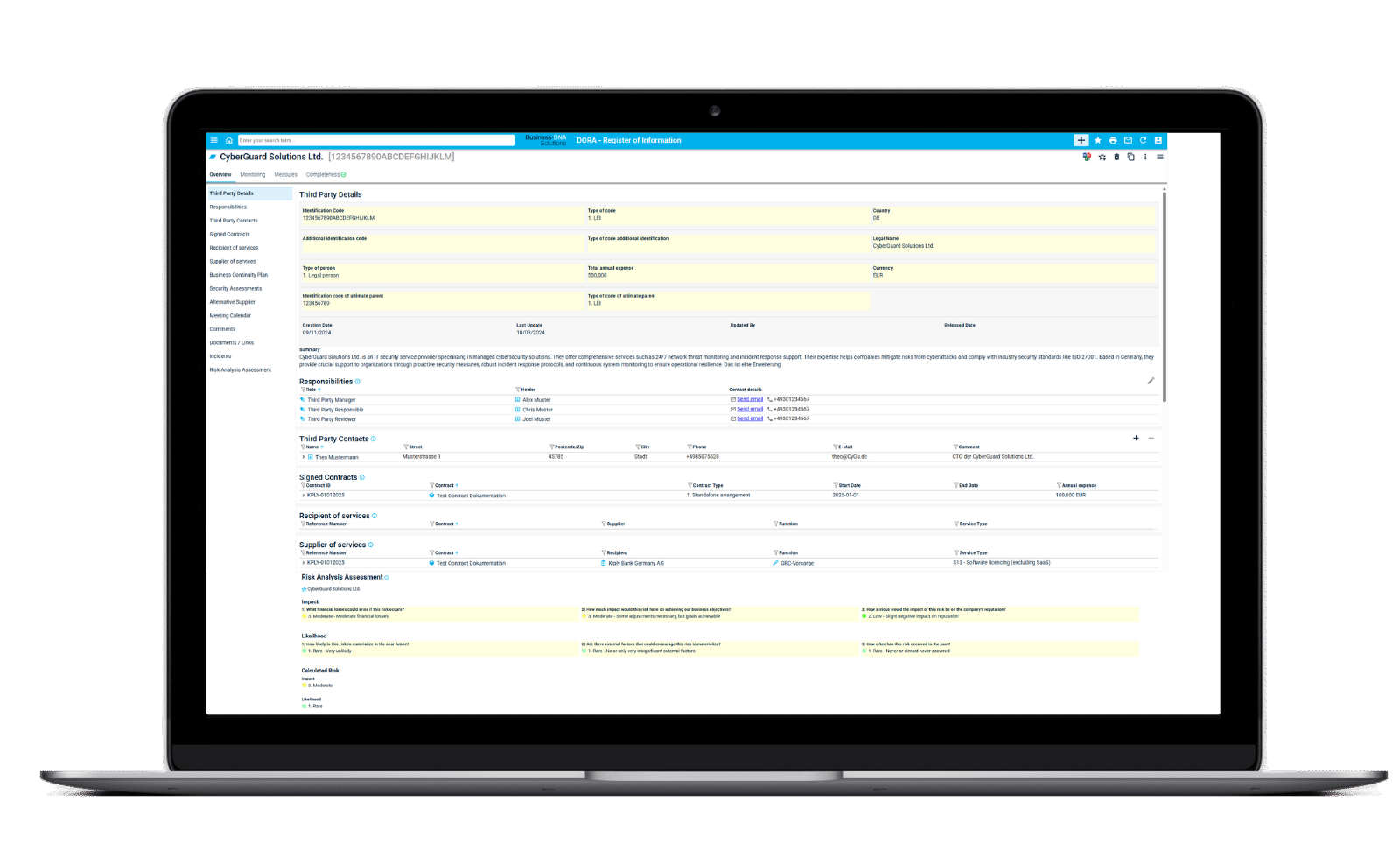
- Register of Information
- Third Party Management
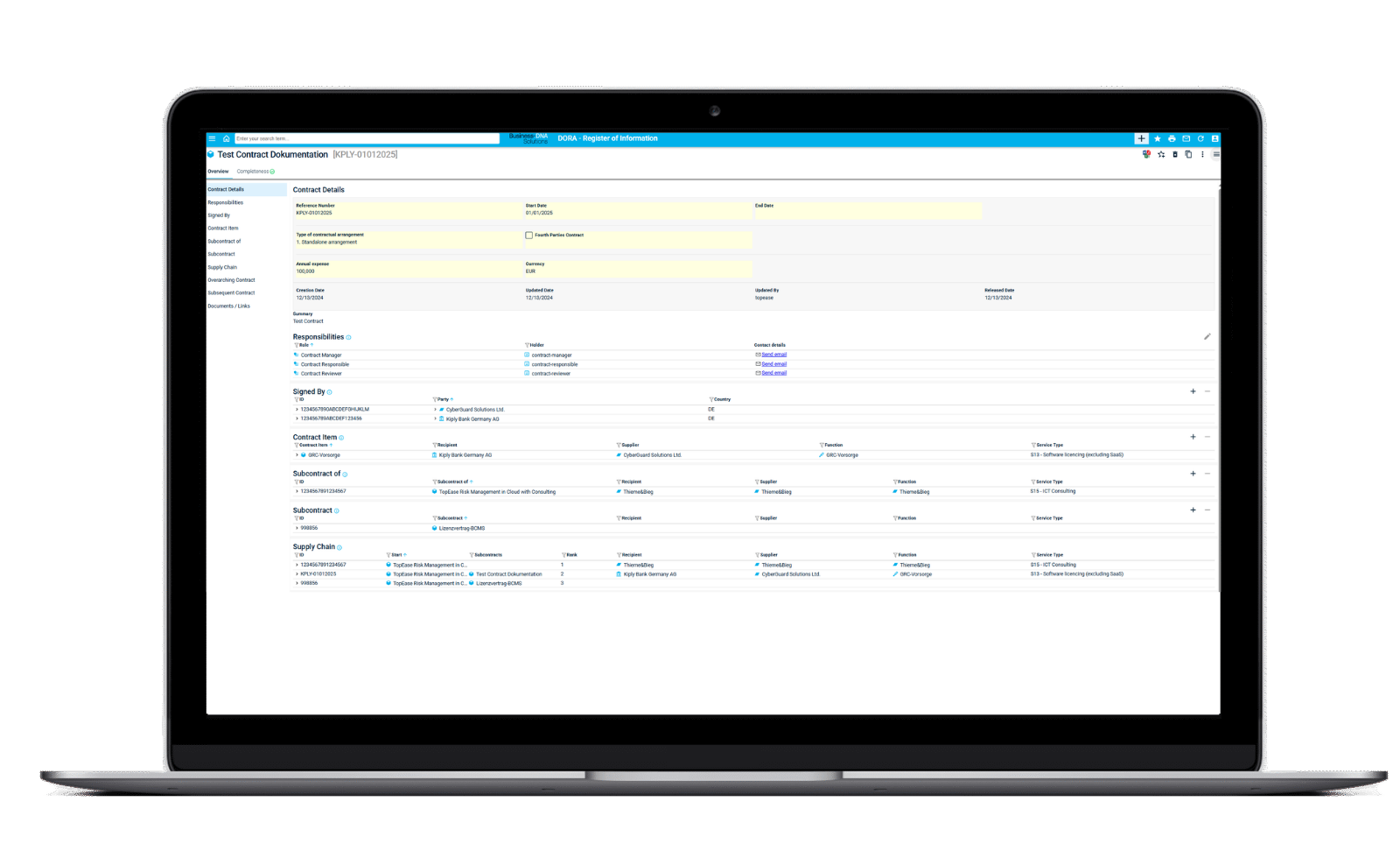
- Contract Management
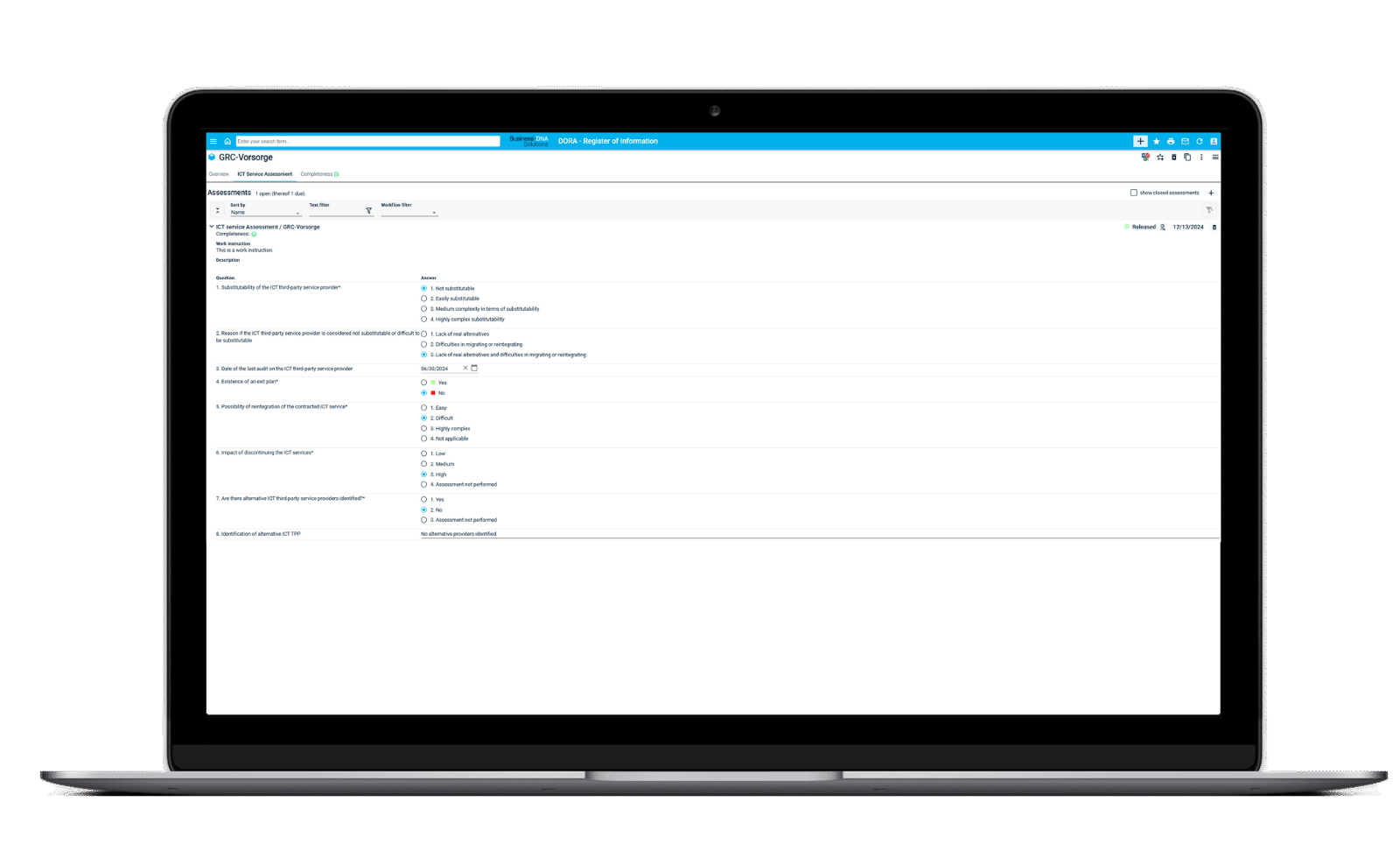
- Asset Assessment
- Measures
Register of Information
Third Party Management
Contract Management
Asset Assessment
Measures
Why choose TopEase over manual processes and standalone DORA tools?
| Manual Processes | Isolated DORA-Software | TopEase-DORA | |
| Digital Twin of the ICT Architecture | x | limited | yes – completely |
| DORA ICT Registry | x manually | partially | yes – automated |
| Integrated ICT Risk Management | x | limited | yes – natively linked |
| Multi-Framework (DORA + NIS-2 + ISO 27001) | x | x | yes – shared database |
| DORA Incident Report (4-hour deadline) | x manually | limited | yes – Workflow-automated |
| Third-party ICT providers, including subcontractors | x | partially | yes – completely |
| Automated BaFin Reporting | x | limited | yes |
| xBRL Export for Filing with the Registry | x | if applicable | yes |
| Integration with BCM, ICS, ISMS | x | x | yes – natively integrated |
| On-Premise & Cloud | x | usually only cloud-based | yes |
| Modular Expansion | x | x | yes |
| Audit Trail & Revision History | x | limited | yes- completely |
Overview of DORA – Requirements, Deadlines, and Classification
Digital Operational Resilience Act – The Regulation at a Glance
- DORA has been mandatory for all financial service providers operating in the EU since January 17, 2025.
- With over 350 requirements in the DORA Regulation itself and more than 100 additional requirements in the Regulatory Technical Standards (RTS), the regulatory framework is significantly more extensive than previous supervisory requirements (XAIT: ~90 requirements, 12 subject areas).
DORA BaFin – What the Regulatory Authority Requires in 2026
- Starting in 2026, BaFin will have fully integrated DORA into its day-to-day supervisory review process. The requirements include: robust processes, proven resilience, complete documentation of all dependencies, and a DORA ICT register in xBRL format that is consistently maintained.
- TopEase supports: Automated BaFin reporting, regulatory filings, and audit documentation – all at the click of a button.
ICT Third-Party Provider Registry
- The complete DORA ICT register must be submitted, including subcontractors, criticality assessments, and data storage locations. Gaps had already become apparent during the 2025 orientation phase.
- TopEase supports: Centralized tracking of all third-party ICT providers and automated maintenance of the registry.
Critical Third-Party ICT Providers (CTPP) – Special Obligations Under Article 31 and Following
- If ICT providers – such as large cloud service providers or systemically important data center providers – are classified as critical by the EU, they are subject to direct supervision by the EBA, ESMA, or EIOPA.
- For financial institutions that use such CTPPs, the existing due diligence obligations under Articles 28–30 are being strengthened: DORA-compliant contract drafting, ongoing monitoring, and a documented exit plan are subject to increased regulatory scrutiny.
- TopEase supports: Comprehensive inventory and risk assessment of all third-party ICT providers – including the identification of particularly critical dependencies and audit-compliant documentation in accordance with Articles 28–31 of DORA.
Relationship to NIS-2 and ISO 27001
- DORA and NIS-2 have overlapping requirements but are aimed at different sectors. ISO 27001 provides the foundation for information security management.
- TopEase supports: Integrating all three frameworks into a single, integrated database – without redundancies.
Who is DORA by TopEase designed for?
CISO (Chief Information Security Officer)
You are responsible for ICT risk management and must demonstrate DORA compliance to senior management and BaFin. TopEase gives you a complete overview—in real time, with no data gaps.
Compliance Officer
You coordinate DORA implementation within the company and must keep track of deadlines, registers, and documentation requirements. TopEase automates workflows and provides a structured way to map all DORA requirements.
Risk Manager
You manage risk assessments, third-party vendor analyses, and control management. TopEase integrates ICT risk management with DORA compliance on a shared data platform, without silos.
Head of IT / CIO
You are responsible for the ICT architecture and the resilience of the IT systems. TopEase maps your entire ICT ecosystem as a digital twin—including third-party ICT providers, subcontractors, and dependencies.
Besonders relevant für folgende Branchen:
- Banks & Financial Institutions: DORA, MaRisk, BAIT
- Insurance: DORA, VAIT
- Asset Management Companies: DORA, KAIT
- Payment Service Providerr:
DORA, ZAIT
- ICT Service Provider for the Financial Sector:
DORA (als kritische Drittanbieter)
- KRITIS operators in the financial sector: DORA (sektorspezifisch) + NIS-2 (infrastrukturrelevant, parallele Pflichten)
“TopEase gives us a comprehensive view of our risk and governance data. Its strength lies in the underlying model, which makes dependencies and influencing factors transparent.“
A. Meier, Raiffeisen Schweiz Genossenschaft

FAQ About DORA and TopEase’s DORA Software
Ready for DORA?
In 2026, BaFin will conduct an audit. Experience in a free Live-Demo, how TopEase structures, automates, and makes your DORA processes ready for audit from the DORA ICT register to automated DORA incident reporting. Our experts will show you the platform live – tailored to your specific DORA requirements.
F24 – The good feeling of being prepared for all critical situations as a company.

You might also be interested in

Risk Management (NFR)
Capture, assess and manage non-financial risks in a structured manner – with a customisable risk map, KRI monitoring and automated workflows.

Control Management (ICS)
Supports the establishment, evaluation and audit-proof documentation of controls – for structured assessment and control management.

OCIR-Management
Supports financial institutions in the structured implementation of operational resilience requirements.