TPRM Software for Transparent Third-Party Risk Management
Whether DORA, NIS2, KRITIS, MaRisk or BAIT – your regulator requires you to demonstrably safeguard your service providers and supply chain. With TopEase, you capture, assess and manage third-party risks in one shared database – across all regulations and without spreadsheets.

We are here for you.
Arrange a personal and unbinding demo appointment now.
What is Third-Party Risk Management (TPRM)?
Third-party risk management (TPRM) is the systematic process of identifying, assessing and managing the risks that arise from external service providers, suppliers and other third parties. TPRM is also referred to as vendor risk management (VRM) or supplier risk management. Organisations don’t just look at the individual supplier: they also examine which services a third party provides, which systems or data it accesses, and how significant it is for their business processes and regulatory requirements.
Typical TPRM tasks range from due diligence – the structured assessment of a third party – and risk classification at onboarding, through assessments and control evidence, to monitoring, remediation management and offboarding. The goal is to assess risks and criticality in a traceable way, assign responsibilities and identify critical dependencies early.
TPRM is no longer just a finance topic: with NIS2 and the KRITIS umbrella act, operators of critical infrastructure and important entities are now required to protect and manage their supply chain and service providers from an information-security perspective.
Manage Third-Party Risk Centrally with TopEase
Scattered data creates blind spots
Contract data spread across file shares, manual risk assessments by email and isolated documentation systems make day-to-day work harder. Risk managers lose track of which systems a service provider can access – and the link between supplier risk and the affected business processes is missing.
One central database for well-informed decisions
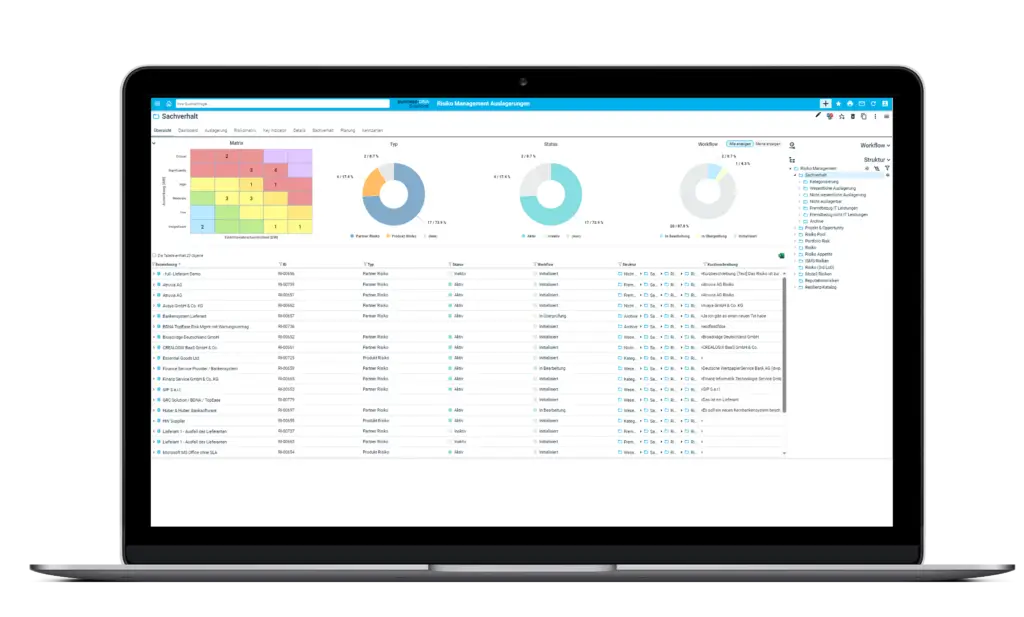
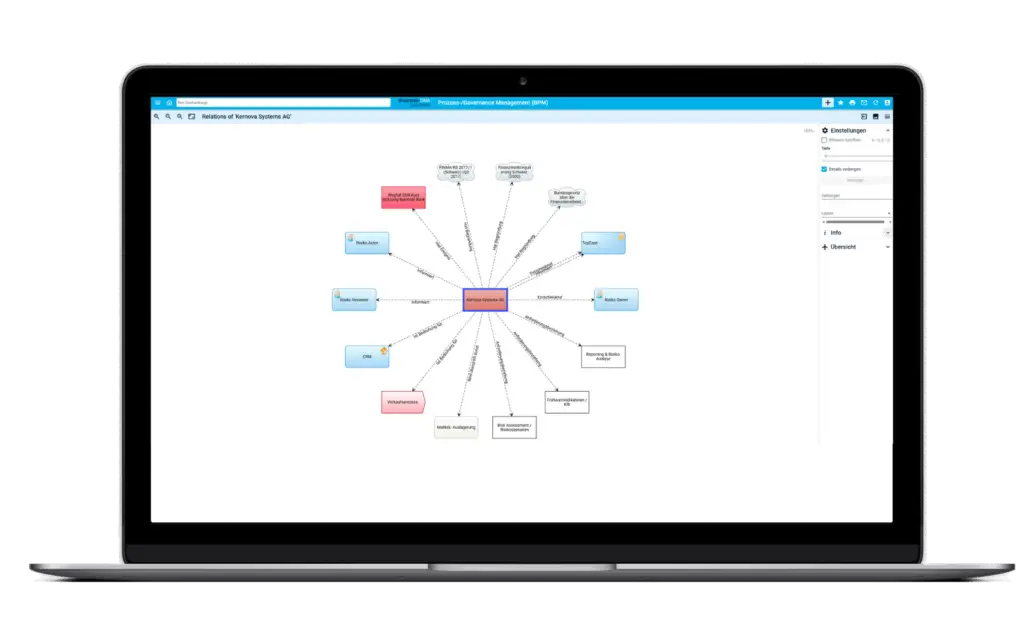
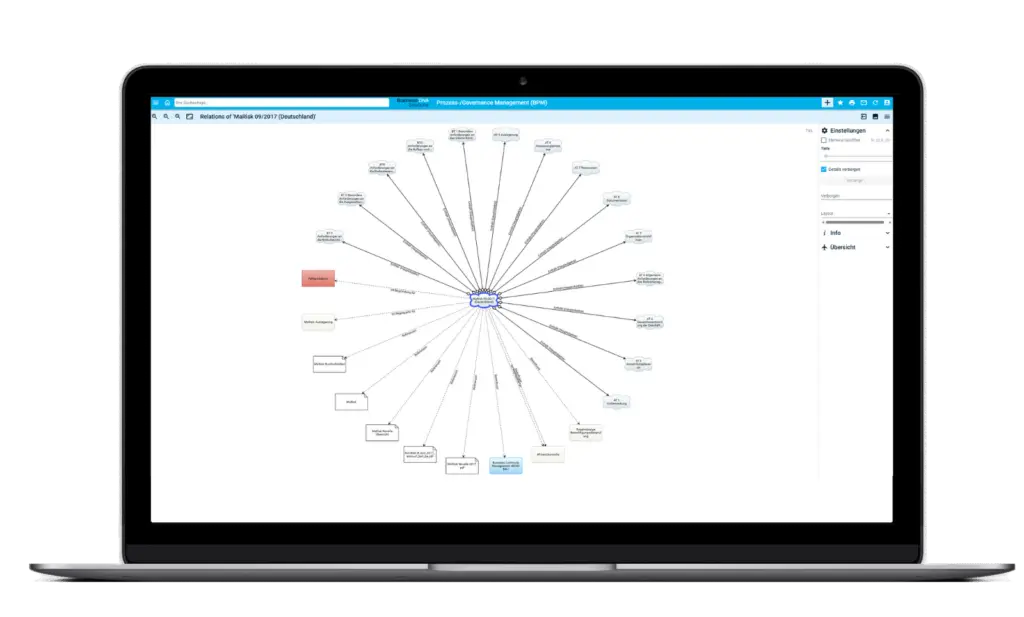
TopEase brings all your scattered information together in one place and connects third parties, contracts, services, IT assets and responsibilities into a multidimensional picture of your risk landscape. When a weak point appears, you immediately see which areas, processes or ICT assets are affected – the basis for fast, targeted decisions.
The Third-Party Lifecycle as a Continuous Cycle
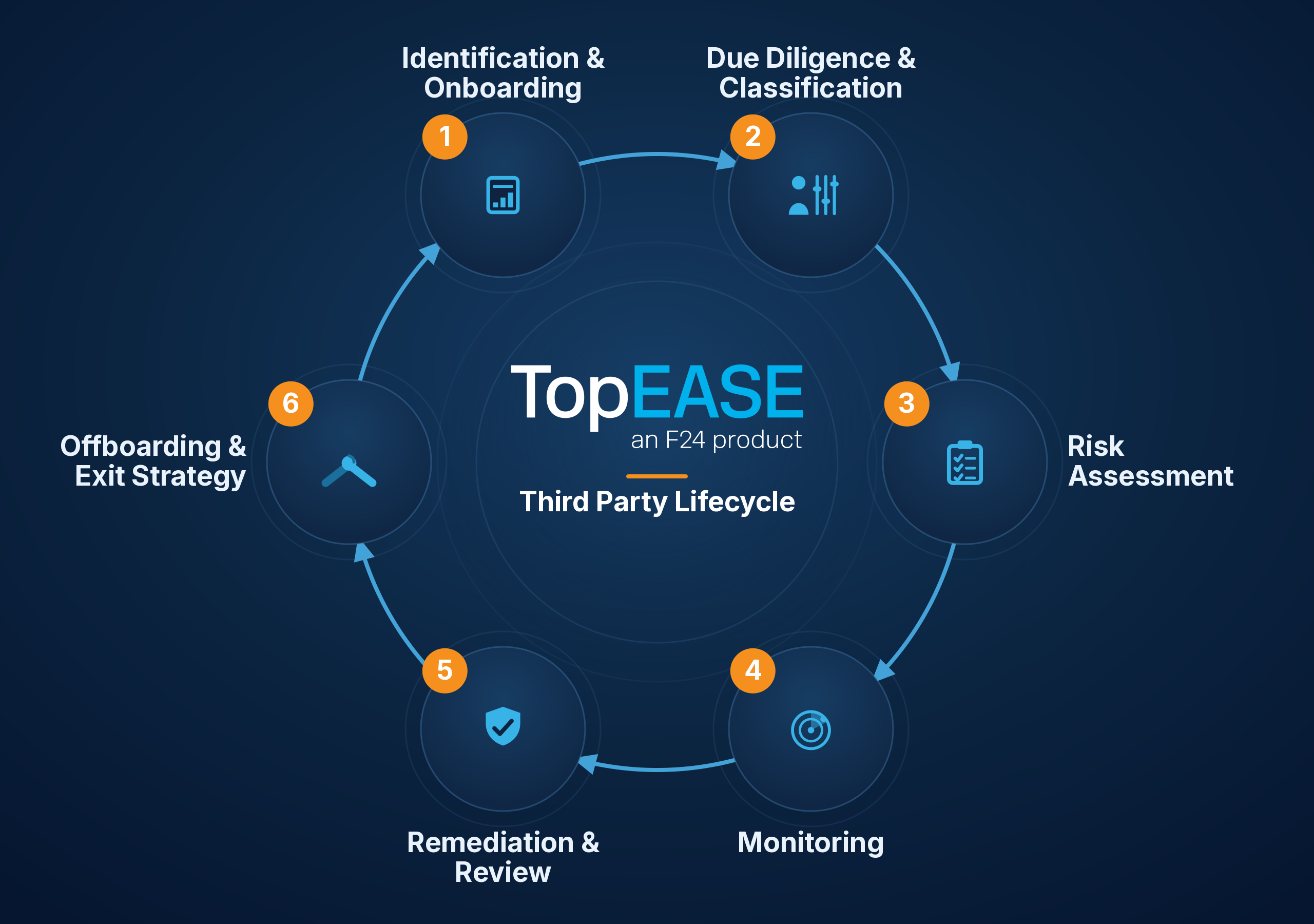
TopEase maps the entire third-party lifecycle in one closed cycle: onboard third parties, classify them through due diligence, assess risks, monitor continuously, derive measures and close out cleanly at offboarding. Each step feeds into the next – with no media breaks and no scattered spreadsheets.
Because third parties, contracts, risks, evidence and measures all sit in one central, redundancy-free database, you get transparent audit trails for management, audit and internal audit – and reports can be generated at the click of a button.
This turns the cycle into a continuous process: every round of monitoring and assessment produces new measures and adjusted classifications – so third-party risk stays up to date instead of being reconstructed once a year for the audit.
Which Risks Does TPRM Identify?
Third parties can create a range of risks for an organisation. These include:
- Information-security risks
- Cyber risks
- Compliance risks
- Operational risks
- Business continuity risks
- Supply chain risks and risks from critical dependencies
- Risks from outsourcing and fourth parties
For ICT service providers, regulatory requirements and risks from digital dependency come on top. These include concentration risks, for example when several business areas or important services depend on just a few external providers – up to a single point of failure in the supply chain.
The risks differ depending on the type of third party, the industry and the criticality of the outsourced service. A TPRM software therefore creates a structured basis for assessing the criticality of third parties and deriving suitable measures.
From DORA to MaRisk – all on one database
Because tiering, criteria and questionnaires are freely configurable, TopEase adapts to your regulatory context – from the financial sector to critical-infrastructure operators.

Capture and assess ICT third-party service providers systematically. Dependencies and concentration risks are made transparent, and the relevant information for DORA third-party risk management is documented in a structured way.
✓ Capture & assess ICT providers
✓ Make concentration risks visible
✓ Structured DORA documentation

Important and essential entities must protect their supply chain from an information-security perspective. TopEase anchors security requirements and incident reporting for each service provider.
✓ Anchor security requirements in contracts
✓ Security incidents & reporting chains
✓ Fourth party & SPOF visibility

Operators of critical infrastructure must safeguard their service providers and suppliers. TopEase maps critical and operator-supporting suppliers together with their evidence.
✓ Classify critical suppliers
✓ Manage evidence & review cadences
✓ Document dependencies

For Swiss banks and financial service providers, TopEase covers the requirements for outsourcing – in the context of FINMA Circular 2017/1 and operational risk management.
✓ Classify material outsourcing
✓ Central outsourcing register
✓ FINMA-compliant documentation

For banks, TopEase covers outsourcing management in line with MaRisk – from the materiality assessment through to the outsourcing register.
✓ Materiality assessment & classification
✓ Maintain the outsourcing register
✓ Review cycles & evidence

For IT outsourcing and other external IT sourcing, TopEase supports the requirements under BAIT and VAIT – including links to applications and controls.
✓ IT outsourcing & external sourcing
✓ Links to applications & controls
✓ Evidence & reports
What’s the difference between TPRM, supplier management and outsourcing management?
A TPRM overlaps with classic supplier management but has a different focus. Procurement and vendor management look at things like sourcing, contractual relationships, cost and service quality. TPRM additionally assesses the risks that arise from working with external parties.

Supplier management
The commercial view of the supplier: sourcing, contractual relationships, cost and service quality – typically through procurement and vendor risk management.

Outsourcing management
The regulatory view of outsourced activities and functions, for example under MaRisk and BAIT, backed by a central outsourcing register.

TPRM
The overarching framework for third-party risks: it connects supplier, contract and outsourcing management depending on the organisation, and additionally assesses the risks of the collaboration.
From traditional term to the modern TPRM view
Depending on the regulation and the department, different terms are used for the same thing. TPRM brings them together under one common framework:
Traditional term
- Outsourcing
- Service provider
- Supplier
- IT outsourcing
- External sourcing
- Subcontractor
Modern TPRM view
- Third-party service
- Third Party
- Vendor
- ICT third-party service
- External service provision
- Fourth party
The core functions of the TopEase TPRM software

Identification & Onboarding
Capture all external partners and service providers centrally in a structured third-party register – including fourth parties. Existing master data can be imported from a file. The benefit: a complete register as your starting point, without scattered supplier lists.

Due Diligence & Classification
Assess criticality and relevant risks right at onboarding, based on defined criteria. An automatic, rule-based tiering classifies each third party by critical data, outsourcing type and operational risk. The benefit: risk-based prioritisation instead of treating every supplier the same.
Risk Assessment
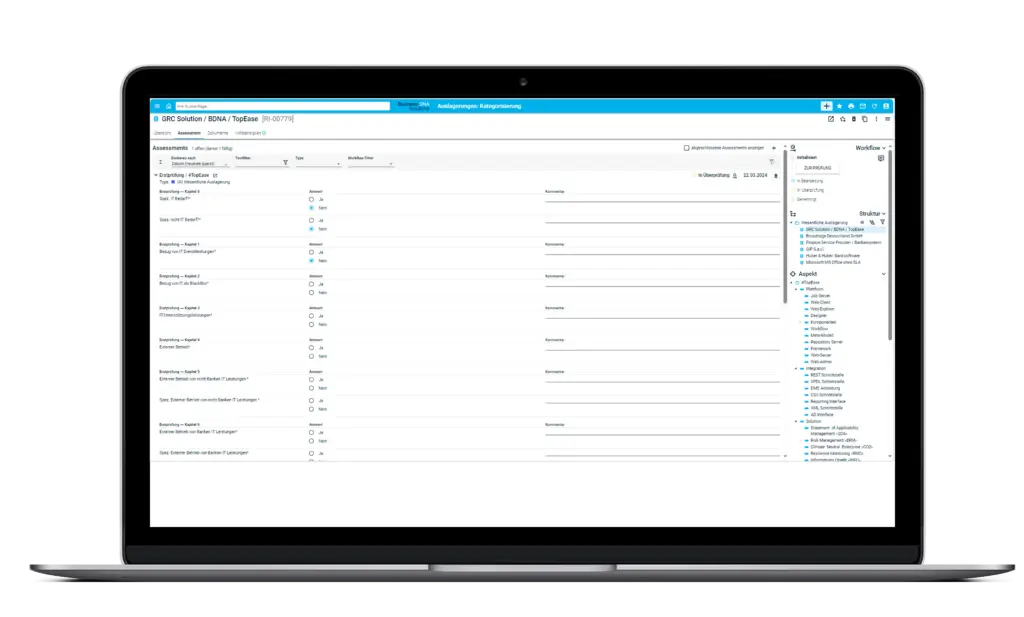
Send dynamic questionnaires and self-assessments to suppliers and calculate risk scores automatically. Security evidence and controls are stored directly with the service provider (control mapping). The benefit: structured, comparable assessments instead of questionnaires by email.

Monitoring
Continuously monitor developments, SLAs and KPIs for critical third parties – complemented by external credit data (e.g. D&B), spend transparency and concentration analysis. Dashboards and automated reports summarise the status for management, departments and auditors. The benefit: early warning on risks and concentration – answers at the click of a button.

Remediation & Review
Identified weaknesses and security incidents at a supplier (e.g. cyberattacks) are documented and trigger targeted measures. Tasks, approvals and assessment loops run through integrated workflows; open to-dos are tracked with an owner and a due date. The benefit: findings become traceable measures – the basis for reporting chains under NIS2 and DORA.

Offboarding & Exit Strategy
Terminate contracts in an orderly way, revoke access rights in a documented manner and return assets. All evidence, assessments and decisions remain fully historised. The benefit: audit-proof trails and a clean exit – you stay able to provide information even after a contract ends.
How TopEase supports a third party – step by step
TopEase supports third-party risk management across the entire lifecycle. From the first record of a service provider, through due diligence and risk assessment, to monitoring, remediation management and offboarding, information and decisions stay traceably documented.
1. Onboarding
Onboarding
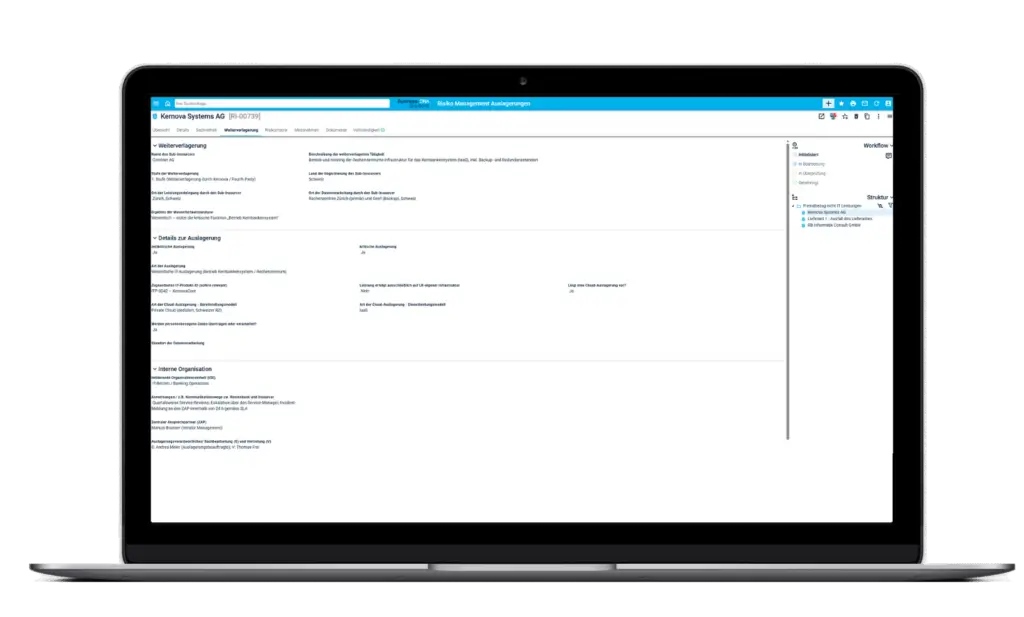
- Integrate service providers via file imports and map them centrally in the third-party register – including fourth parties.
2. Due Diligence
Due Diligence
- Assess criticality and risks right at onboarding, based on defined criteria. A rule-based tiering automatically classifies each third party by significance.
3. Risk Assessment
Risk Assessment
- Run dynamic questionnaires and self-assessments and calculate risk scores automatically – comparable across all third parties.
4. Monitoring
Monitoring
- Continuously track developments, SLAs, KPIs and events such as security incidents. Credit and spend data make concentration risks visible early.
5. Remediation
Remediation
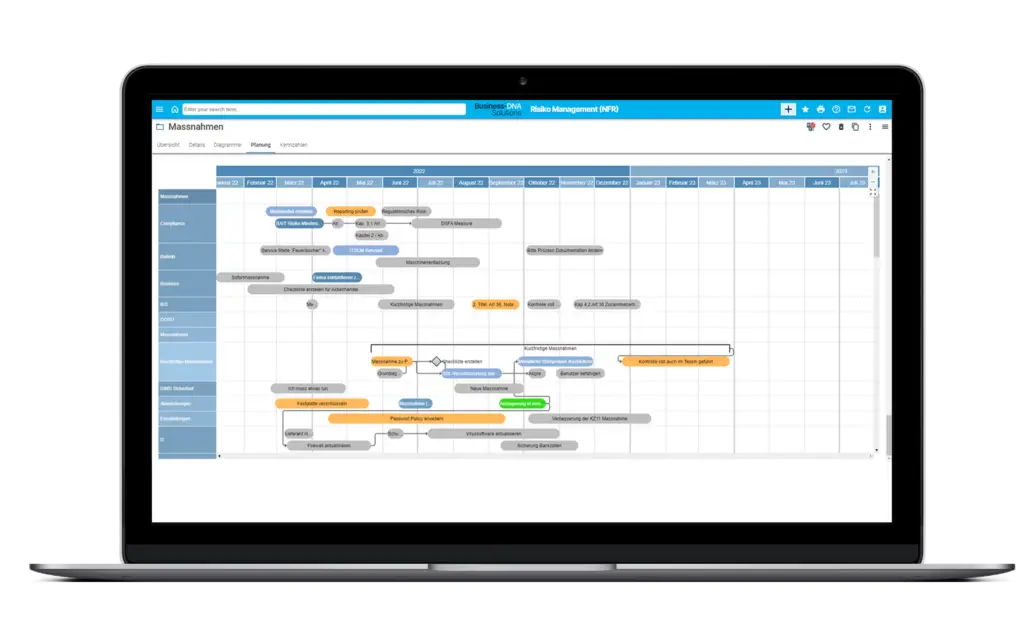
- Address weaknesses, assign owners and due dates, and track open measures through to completion – findings become measures.
6. Offboarding
Offboarding
- Terminate contracts, revoke access rights and return assets. A defined exit strategy and historised evidence ensure a clean, audit-proof close-out.
The benefit: TPRM stays traceable across the entire lifecycle of a third party.

Which roles benefit from TPRM?
TopEase supports different roles along their respective tasks in third-party risk management.
TPRM as part of the TopEase GRC platform
A TPRM solution delivers its greatest value when it doesn’t view third parties in isolation. TopEase third-party management shares a single, redundancy-free database with the adjacent TopEase modules.
This modular architecture lets you:
- Manage contracts centrally: Link third parties to Contract Management – NDAs, SLAs and deadlines, audit-proof and in one place.
- Connect risks & controls: Couple supplier risks with Risk Management and internal controls (ICS) to monitor effectiveness and coverage effectively.
- Make ICT dependencies visible: Link third parties to the applications and infrastructure from Asset Management (EAM) and to the affected processes.
- Embed information security: Apply protection needs and security controls from the ISMS to service providers – the basis for supply chain security under NIS2.
- Safeguard resilience & exit: Cushion concentration risks and failure scenarios with Business Continuity (BCM/BIA), with no redundant data upkeep.
How third-party risk management works with TopEase in practice
- Custom Dashboards
- Outsourcing Overview
- Supplier Assessment
- Onward Outsourcing & Fourth Party
- Relationship Overview
- Regulations & Requirements
- Remediation Planning
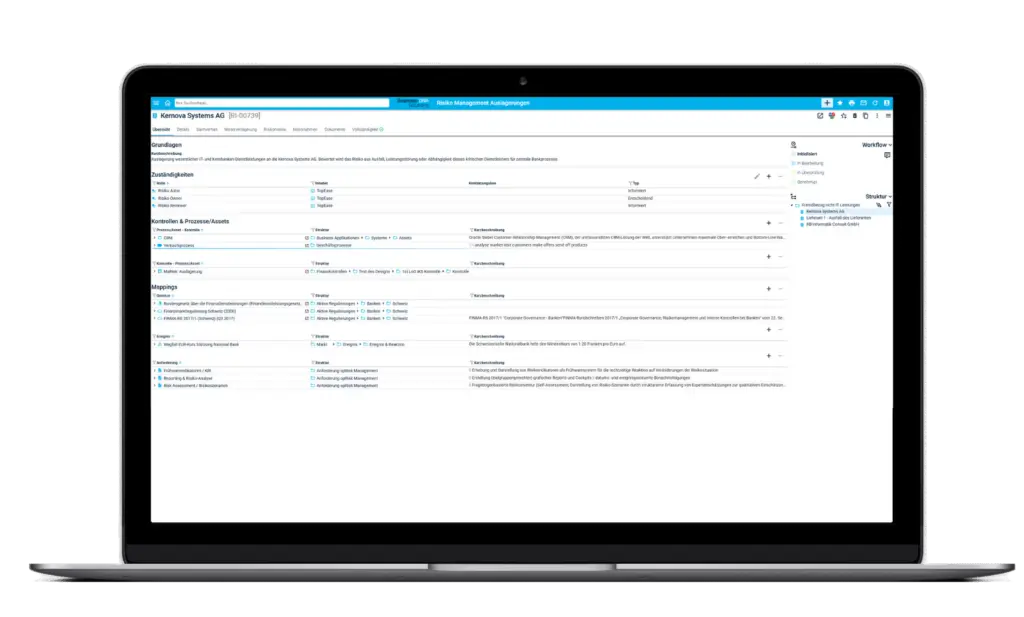
Supplier Assessment
“TopEase gives us a comprehensive view of our risk and governance data. Its strength lies in the underlying model, which makes dependencies and influencing factors transparent.“
A. Meier, Raiffeisen Schweiz Genossenschaft

Frequently asked questions about TPRM and TopEase
We are here for you.
We are happy to answer your questions about TopEase.
Optimise your Third-Party Risk Management now with the TopEase TPRM software
With TopEase, you create a shared database for third parties, risks, contracts, processes, assets, controls, evidence and measures. You capture service providers centrally, assess risks in a structured way, steer assessments and measures, and make critical dependencies visible.
In a personal and non-binding live demo, our GRC experts show you how TopEase captures third parties, assesses risks, supports assessments and makes dependencies visible within your GRC structure.
F24 – The good feeling of being prepared for all critical situations as a company.

You might also be interested in

Assetmanagement (EAM)
Manages IT architecture, systems and infrastructure centrally and provides visibility of dependencies between assets, processes and risks.

Risk Management (NFR)
Capture, assess and manage non-financial risks in a structured manner – with a customisable risk map, KRI monitoring and automated workflows.

Processmanagement (BPM)
Visualises business processes and links them to risks, controls and assets – for a transparent, silo-free process landscape