OCIR software for structured resolution planning
For critical services to keep running during a resolution, you need clarity about which services are relevant and what they depend on. With TopEase, you capture, assess and connect business activities, services and assets in one shared database – traceable and without scattered spreadsheets.

We are here for you.
Arrange a personal and unbinding demo appointment now.
What is Operational Continuity in Resolution (OCIR)?
Operational Continuity in Resolution (OCIR) describes the organisational and operational conditions that enable banks to ensure relevant services can still be provided during a resolution (bank resolution), and that the planned resolution measures are operationally supported. At its core is the question of which services are needed to continue relevant business activities, and what their provision depends on.
The TopEase OCIR software maps this information in one central database. Business activities, internal services, assets, responsibilities and OCIR relevance assessments are connected with one another and used to build and continuously update the service catalogue.
This is how TopEase helps banks present service chains and dependencies transparently and build a reliable information basis for resolution planning.
Why OCIR quickly becomes complex in practice
Reliable resolution planning often fails in practice because of scattered OCIR data. When information on business activities, services, assets and dependencies sits in spreadsheets and isolated departmental systems, the transparency needed for a consistent relevance assessment and reliable evidence is missing.
Challenges in practice:
- Scattered data: Business activities, services, assets, contracts and responsibilities sit across different systems and departments.
- Complex dependencies: Without structured mapping, it’s hard to trace which services are relevant to a business activity and what they depend on.
- High manual effort: Service catalogues, assessments and reports are maintained in spreadsheets – leading to duplicated work and outdated data.
- Short-notice evidence demands: Audit, internal review or supervisors often need reliable information at short notice – that’s when it shows how current the documentation really is.
How TopEase OCIR software solves these hurdles:
- One shared database: Business activities, services, assets, responsibilities and OCIR relevance assessments are captured centrally and connected with one another.
- Transparent dependencies: Service chains and the resources they require are connected and made visible in a traceable way.
- Structured workflows and reusable data replace scattered spreadsheets – which cuts duplicated work and keeps the data current.
- Audit-proof evidence: Changes feed straight through to the relevances – with transparent audit trails for reporting, audit and supervisors.
Which OCIR-relevant information can you map with TopEase?
A reliable OCIR analysis has to reflect the reality of your bank. That’s why TopEase gives you a data model that is structured yet flexibly configurable. It lets you capture business activities, internal services and the assets they require, and logically connect their dependencies to one another.
OCIR element
- Business activities
- Internal services (business processes)
- IT systems and applications
- Personnel
- Buildings and locations
- External services and contracts
Typical examples
- Lending, payments, treasury, regulatory reporting
- New lending business, loan syndication, problem-loan management
- Core banking system, business applications, interfaces
- Key functions, teams, knowledge holders
- Data centres, operating sites, branches
- Service providers, outsourcing, contractual relationships
Manage OCIR centrally with TopEase
From capture to the complete overview
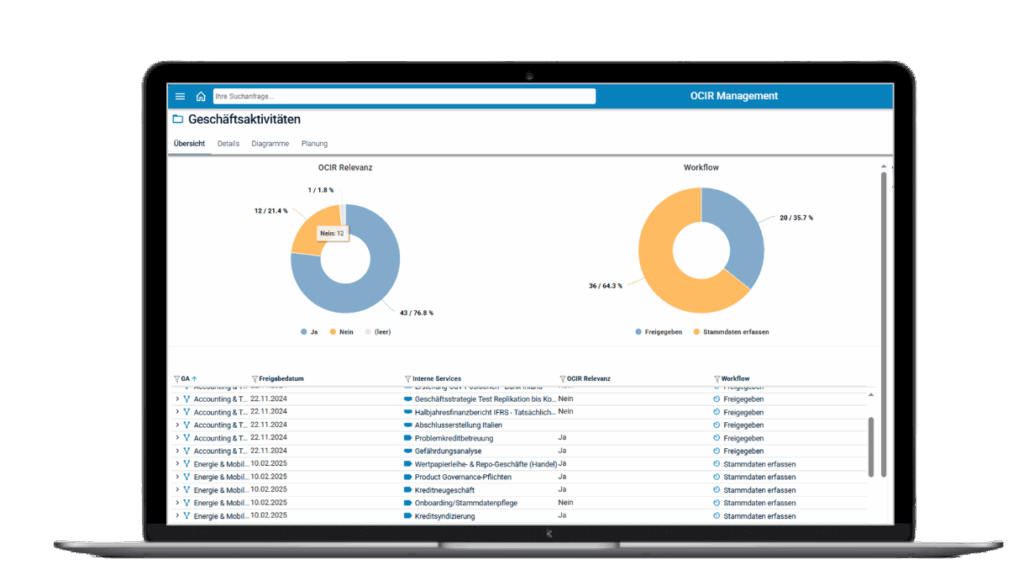
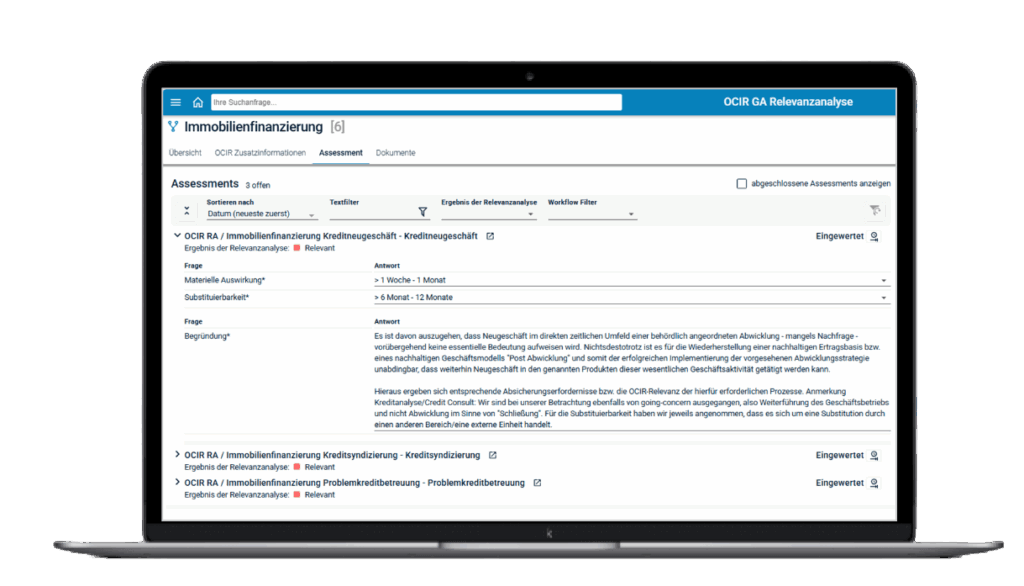
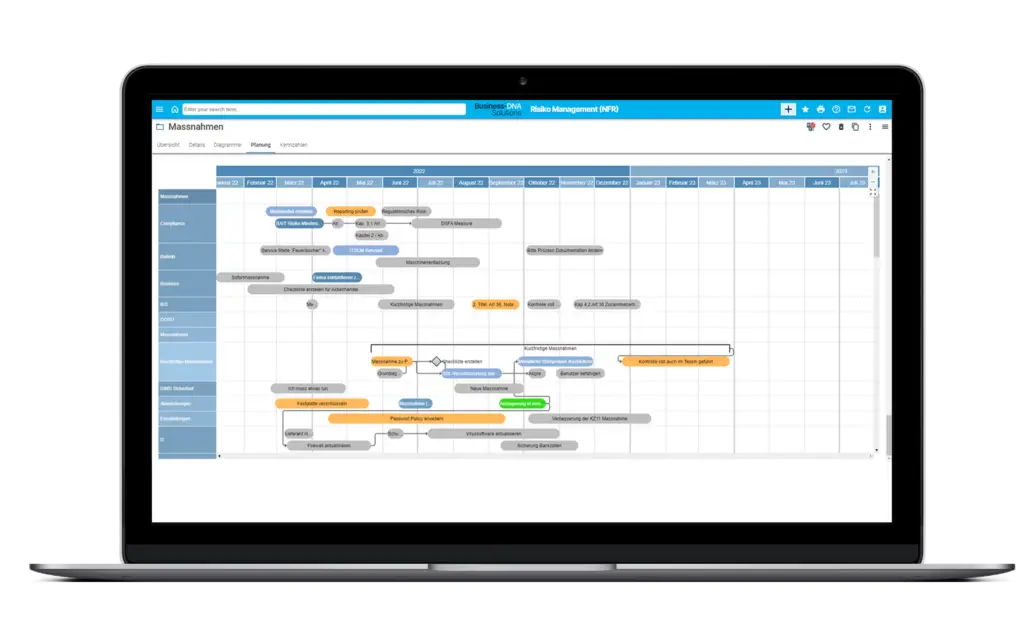
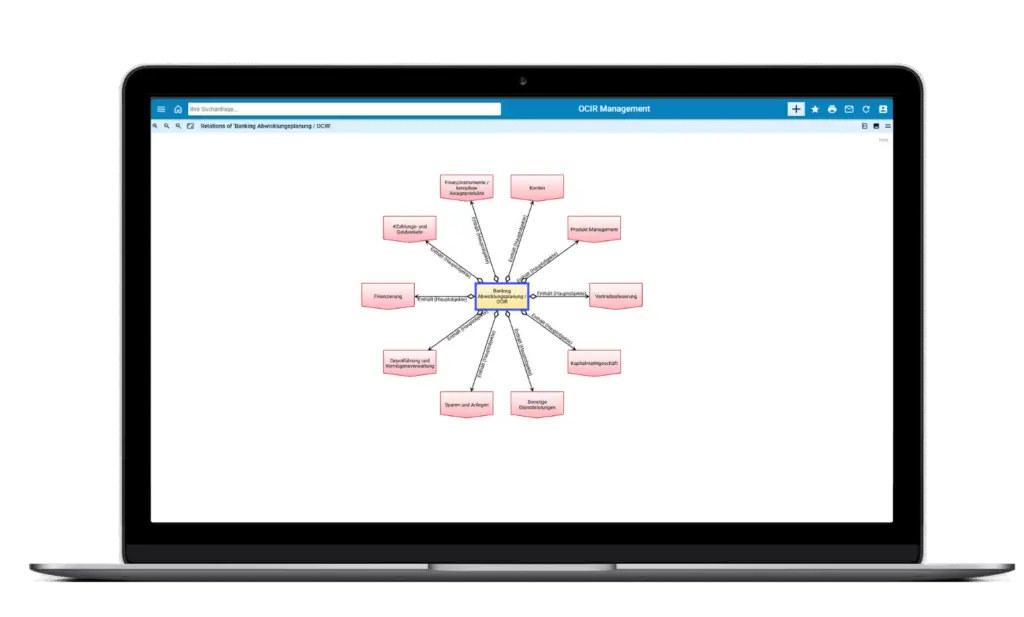
The following views show how TopEase maps the OCIR process in the tool: from the relevance analysis per business activity through to the detailed assessment of the assigned internal services. For each business activity, it stays visible at all times which services are relevant and how they have been assessed.
Always current and traceable
Because all information sits on one shared database, assessments, responsibilities and dependencies remain traceable at all times. When processes or assets change, this feeds straight through to the associated OCIR relevances – with no need to reconcile results manually.
Your benefits with the TopEase OCIR software

All OCIR information on one database
Business activities, internal services, operational assets and OCIR relevance assessments are captured centrally and connected with one another – rather than scattered across separate lists, documents and departmental systems.

Trace service chains and dependencies transparently
See which services are relevant to individual business activities and which assets and resources are needed to deliver them. This also makes complex dependencies within the service chains visible.

Adaptable to your assessment concept
TopEase doesn’t impose a rigid OCIR methodology. Assessments, assessment criteria and relevance logic can be adapted to your existing concept – so you reflect established ways of working instead of adapting them to a tool.

Always current instead of rebuilt once a year
When processes, assets or responsibilities change, the affected assessments are re-triggered. This keeps the information basis for service catalogue, assessments and reporting continuously up to date – without having to rebuild it before every review.

Clear responsibilities
Link relevant services to the responsible roles and organisational units, and create transparent governance structures.

Standardised reports instead of manual preparation
Standardised analyses – including supervisor-required reports – can be generated directly from the current database. This speeds up the delivery of reliable information for reporting, audit and supervisory purposes and removes the manual preparation in separate lists.
The OCIR process as a continuous cycle
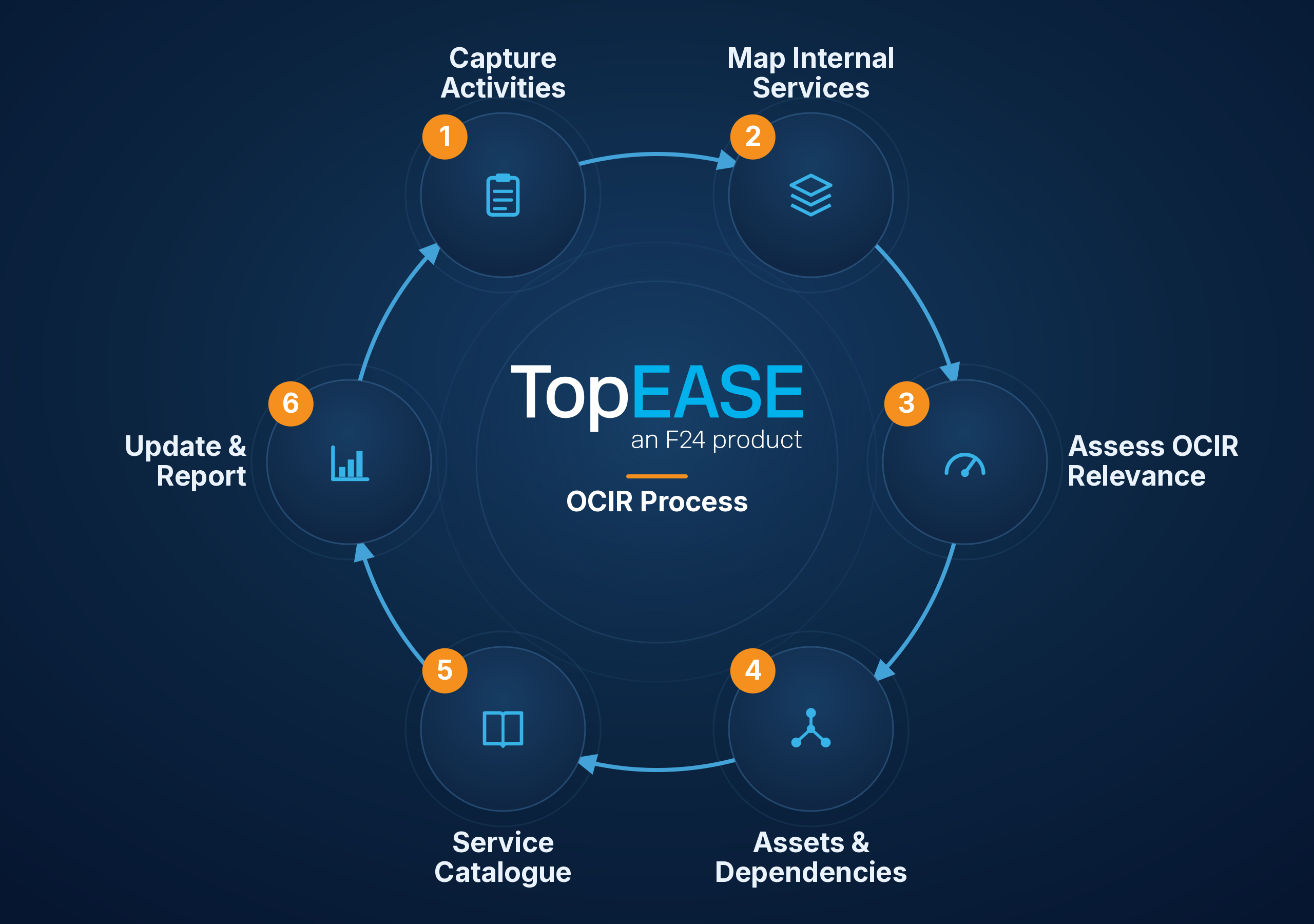
TopEase maps the entire OCIR process in a closed cycle: capture business activities, assign internal services, assess their OCIR relevance, connect assets and dependencies, build the service catalogue, and update and report on an ongoing basis. Each step feeds into the next – with no media breaks and no scattered spreadsheets.
Because business activities, services, assets, assessments and responsibilities sit on a single, redundancy-free database, transparent audit trails emerge for management, audit and supervisors – and standardised reports can be generated directly from the current data.
This turns the cycle into a continuous process: when processes, assets or responsibilities change, the affected assessments are re-triggered automatically – OCIR relevance stays current at all times, instead of being rebuilt once a year for reporting.
How does OCIR differ from DORA and Business Continuity Management (BCM)?
OCIR, DORA and Business Continuity Management (BCM) all deal with the resilience and continuity of organisations, but they address different situations: while OCIR looks at the resolution scenario, DORA centres on digital operational resilience in the financial sector. BCM, in turn, ensures business continuity during disruptions and outages.

DORA
Digital Operational Resilience Act: digital operational resilience and the management of ICT risks in the financial sector. This includes ICT risk management, the management of ICT third parties and digital resilience testing.

BCM / BIA
Business Continuity Management (BCM): business continuity during disruptions and outages – business impact analysis, emergency and recovery planning, and BCM tests. BCM looks at the unplanned event, not the planned resolution scenario.
OCIR
Operational Continuity in Resolution: the operational continuity of relevant services in the resolution scenario. At its core are the assignment of relevant services to business activities, the mapping of the required assets and dependencies, and providing evidence to supervisors.
How TopEase structures your OCIR process
TopEase supports the OCIR process across the entire workflow. From capturing business activities through the assignment and assessment of internal services to the service catalogue and ongoing reporting, information and decisions stay traceably documented.
1. Capture business activities:
Capture business activities
- Build an inventory of your business activities and processes. Relevant and non-relevant activities are documented centrally and form the basis for the further analysis.
2. Assign internal services:
Assign internal services
- Break down the services needed to carry out a business activity. This makes responsibilities and relationships immediately visible.
3. Assess OCIR relevance:
Assess OCIR relevance
- Assess business activities and internal services for their relevance to resolution planning. Status and assessment results stay centrally traceable.
4. Link assets:
Link assets
- Document the resources a service requires – such as IT, personnel, buildings and internal and external services – and map their interrelationships.
5. Build the OCIR service catalogue:
Build the OCIR service catalogue
- Bring relevant information together in a structured service catalogue that documents services, dependencies and OCIR relevances in a traceable way.
6. Update and report:
Update and report
- Adjust data when there are organisational or technical changes, and use the current information basis for status overviews, analyses and reports.
The benefit: your OCIR analysis stays traceable and current across the entire process.

Which roles benefit from OCIR?
TopEase supports various roles along their respective tasks in the OCIR process.
OCIR as part of the TopEase GRC platform
OCIR delivers its greatest value when business activities, services and assets aren’t captured in isolation, but taken from the existing GRC context. The OCIR module shares a single, redundancy-free database with the adjacent TopEase modules.
This modular architecture lets you:
- Reuse processes and assets: Use business processes and resources from Process Management and Asset Management (EAM) as the OCIR basis, instead of capturing them anew.
- Factor in service-provider dependencies: Feed external services and contractual dependencies from Outsourcing Management into the OCIR relevance.
- Build on BCM assessments: Use processes already assessed in Business Continuity Management (BCM/BIA) without maintaining data twice.
- Connect results with governance: Link OCIR-relevant services and assets to Risk Management and internal controls (ICS).
The TopEase OCIR software in action
Relationship overview
“With TopEase, we are establishing an integrated, object-oriented approach to linking enterprise architecture and GRC management – in a transparent and controllable manner.”
B. Schmidiger, RUAG MRO Holding AG

Frequently asked questions about OCIR and TopEase
We are here for you.
Arrange a personal and unbinding demo appointment now.
Ready for structured resolution planning? Get to know TopEase.
See in a free live demo how TopEase digitalises your OCIR analysis: from capturing business activities through relevance assessment to the OCIR service catalogue. Our experts show you the platform live, tailored to your specific OCIR requirements.
F24 – The good feeling of being prepared for all critical situations as a company.

You might also be interested in

DORA
Covers all the requirements of the Digital Operational Resilience Act – from ICT risk management and the third-party register to automated reporting to BaFin

Business Continuity Management (BCM)
Helps organisations to plan business continuity in a structured manner – from business impact analysis to recovery plans, in accordance with ISO 22301 and BSI 200-4.
Outsourcing (TPRM)
Systematically identifies, assesses and manages third-party risks and outsourcing – from criticality and materiality assessments through to the compliance-compliant management of suppliers and ICT service providers in accordance with MaRisk, DORA and ESG.